Friday, December 16, 2016

Luis Buñuel on Blu-ray with one of his best -- THE EXTERMINATING ANGEL


An artist at work and very near (hell, maybe at) the top of his form can be seen in THE EXTERMINATING ANGEL, the 1962 Mexican movie from that world-class filmmaker, Luis Buñuel.  While I run hot to luke-warm on this fellow's overall oeuvre, this particular film is one of my favorites -- which I have seen maybe only once since I first viewed it on its New York debut at the New York Film Festival, back, I believe, in 1963. At that time, the movie provoked the usual reactions from the cultured crowd -- What's going on here? Why is it happening? Is this a metaphor, and if so, for what? --  dividing audiences, of course, but also grabbing them for the film's duration.

That the movie is also all about "the cultured crowd," Mexican version, is no accident. In it, Señor Buñuel (shown at left) tweaks his usual suspects: Class, Religion, and bourgeois hypocrisy. But how he does this is what counts. Why, together with what this means, is left a mystery, but with clues scattered generously about so that we can each draw our own conclusion, while feeling reasonably sure that, of course, this is what Buñuel must have meant. If only Luis were ever that easily "pinned down."

Back in 1963, audiences were only just beginning to tackle movies that had to be deciphered, and we weren't nearly as adept at it as we -- well, some of us -- are now. Seeing The Exterminating Angel again today may also make you realize that deciphering is not all that mandatory. We don't need to know everything. In fact, here, it is best to sit back, relax and go with the flow.

The tale told is of a dinner party among the very wealthy and class-conscious. We see preparations for the party taking place, as certain members of "the help" take their leave of the mansion before that party even begins. Class is already raising its nasty little head.

The guests arrive, are seated and witness a shocking accident that oddly provokes laughter. They eat, they chat, they listen as one of their own plays the piano, and then... they don't leave. They stay and stay and stay. A performing bear and some sheep make appearances (Communism and Religion? Nah: that's too easy). And our pampered guests go slowly from bad to worse.

Just as they are unable to leave the room in which they find themselves trapped (is this some kind of mass agoraphobia?), neither can the outside world find the will or the way to enter this now captive mansion. In other hands we'd have something "magical" and/or otherworldly. Buñuel smartly makes it seems so ordinary and oddly almost normal that we buy it, even as we keep questioning 'why.'

Performances from every last actor are on the nose. This moviemaker had a knack for casting and making sure his cast delivered. Best known among them is probably the lovely Silvia Pinal (above, center), whose character may be more (or less) than we perceive. (There a great interview with Ms Pinal today -- or fairly recently, at least -- in which she talks about Buñuel and his movie-making methods. It's a delight to see, hear and consider.)

Available now on Blu-ray and DVD from The Criterion Collection, the movie -- in Spanish with English subtitles -- runs only 95 minutes. But those minutes are fully packed with amazement and surprise. And as usual with Criterion, the movie arrives with a very nice array of supplementary "bonus" materials.

The photos above are from the film, 
with the exception of Buñuel's 
which is by Jack Manning
and comes courtesy of Getty Images.

Thursday, December 15, 2016

Poet, politico, man and myth: Pablo Larraín's multi-faceted biopic/fantasy, NERUDA


Older Americans of a progressive slant will be familiar with the Nobel-winning Chilean poet Pablo Neruda, I suspect. But unless they are very familiar with the man's history, much of NERUDA, a new film from Chilean director Pablo Larraín, whose new film Jackie is also currently playing (and will be reviewed here next week), may strike them as surprising and bizarre. That's just fine, however, because -- from what TrustMovies can gather about Larraín's film -- this is indeed a kind of fantasia of what-if? and what-then?

The movie builds off facts, all right -- what we may already know about Neruda's life and art -- and what the screenwriter, Guillermo Calderón (of The Club), does in his very nearly completely invented story, is to wrap it all around a real time in Neruda's life (the 1940s) when he had to go on the run from the anti-Communist Chilean authorities who were (as usual and as a few decades later: remember Pinochet?) in the pocket of their North America "teachers." In filming Calderón's screenplay, Señor Larraín, pictured at right, has given us his most poetic movie so far.

Neruda may move slowly but the tale it spins is strange and gorgeous, witty and ironic, buoyant and sad. In the leading role is an actor who looks remarkably like Neruda himself (at least in some of the extant photos we can access, as the one below), Luis Gnecco (shown at left). Gnecco captures the artist, the politician, and the man equally well, succeeding in making us understand how Neruda was able to concoct the myth that surrounded him via the help of both his friends/fans and even more so with the help of his enemies.

After all, when the right wing calls you a traitor to your country, isn't it rather a badge of honor? Pablo was evidently a man of very healthy appetites, many of which are shown us throughout the movie. And yet it is hard not to love him for his excesses, as much as for his talent and political savvy. But Señor Gnecco shares screen time with a co-star much better known in America and internationally, Gael García Bernal (below), who plays a fictional character named Óscar Peluchonneau, a full-of-himself policeman who is given the job of finding and arresting (or maybe even killing) Neruda.

Óscar also narrates the film, and a more unreliable narrator would be hard to come by. But this is part of what makes the movie so often such fun. The policeman's idea of life and art and his place in it all is far afield from any reality we can see, and as the film marches forward, Óscar's ideas grow funnier but also sadder, even a bit poignant.

Mercedes Morán, a beautiful actress with wonderful access to emotional depths (shown above), plays Neruda's woman, and she's a pleasure to watch in all her scenes. Also in the cast is Larraín regular, Alfredo Castro, in a role small enough that you might miss that notable face.

The movie plays with politics and art, reality and fantasy, storytelling and the "heroic protagonist" (this is the role our Óscar dearly wants to assume) -- all to very good effect. It is beautiful to look at, as well, never more so than in the film's final scenes in the snowy Andes mountains where predator and prey will finally meet. Sort of.

Along the way we get snippets of Neruda's poetry, too, and if I have not made if clear that more than a passing interest in this poet is probably a requirement of the film, then let me do that now. I suspect that Chileans probably flocked to the film in a similar way that Americans will do with Jackie, a north-of-the-border mythmaker in her own way.

Meanwhile, Neruda -- from The Orchard and Participant Media, running 107 minutes, in Spanish with English subtitles -- opens tomorrow, Friday, December 16, in New York City at the IFC Center and the Film Society of Lincoln Center, in Los Angeles at Laemmle's Royal, and in Toronto at the TIFF Bell Lightbox. In the weeks to come it will hit a number of other cities, too. Click here to see all currently scheduled playdates.

Wednesday, December 14, 2016

The glorious highs -- and unfortunate lows -- of Damien Chazelle's LA LA LAND


The opening number of LA LA LAND, as you've by now most likely heard, is a five-star wonder. It is almost as if that famous traffic pile-up from Godard's Weekend had suddenly taken flight into the realm of the Hollywood musical. Damien Chazelle's new movie owes much more, however, to the work of Jacques Demy than anyone else I can think of. And if it doesn't manage to come up to Demy's level of marvel (who could?), it remains, at its best, a splendor to behold. At least for those of us who can still appreciate the delights of the not-so-often-seen-these-days movie musical. We're here, all right, but we may not be in large enough numbers to make this critic's darling an all-out box-office blockbuster.

Mr. Chazelle, pictured at left, whose third and best film this is -- after the initial sleep-inducing Guy and Madeline on a Park Bench and the propulsive but utterly over-the-top and unbelievable Whiplash -- has written and directed something that works very well on one level (as a musical) but merely OK on another (as a character-based romance). His characters, as usual, are paper-thin -- they're all motivated by one thing and one thing only -- even if (also as usual), they are played by very good actors -- in this case, Ryan Gosling and Emma Stone, shown above and below. Even the supporting cast is filled with creme-de-la-creme, although they are, to an actor, under-used in the extreme.

But since it is Gosling and Stone who must do all the heavy-lifting, we pretty much disregard the rest of the cast, except to note in passing, "Oh, look: There's Rosemarie DeWitt (below). Or J.K. Simmons (further below) Or John Legend! (shown at bottom)." And yes, there they all are.

The story, too, could hardly be more pedestrian. Boy and girl want a career and each other. But it seems as though these two goals are incompatible. At least in the universe of Mr. Chazelle. So they -- and we -- must settle.

There are compensations -- for both the characters and us viewers. Their careers turn out to be achievable, all right. (This is a Hollywood movie about Hollywood, after all.) And La La Land, for its audience -- depending on how much one can overlook -- is often at least a semi-delight.

The music, including even the much-vaunted City of Stars, is not particularly memorable, although there is that nifty opening number, and Ms Stone gets to sing one wonderful song toward movie's end that is beautifully written and performed.

What drags the movie down is its would-be love story between two people who really don't have much character, other than their often talked-and-sung-about "dreams." These two are walking clichés. They're fine, and then all of a sudden, with some space between them, they're not. And as much specificity as Stone and Gosling attempt to bring to their roles, the pair remains, alas, cardboard. Oh, movie fans and the very young will identify, all right. But the more jaded or simply experienced among us will want more.

The dancing, too, while sometimes lovely and seemingly almost improvised, is also not especially professional. There's no budding Gene Kelly, Fred Astaire, Cyd Charisse or Leslie Caron on view. So La La Land, for all its outreach and occasional success, must be judged a worthy attempt that provides some pretty good entertainment, and includes some really lovely colors, costumes and production design. We are indeed starved for musicals, however, so this one certainly fills the bill for now.

After opening in the culture capitals a week or so back, the movie -- from Lionsgate and running two hours and eight minutes -- opens across the country this Friday. Here in South Florida you can view it at a number of local theaters. Wherever you are, to find the theater nearest you, simply click here.

Tuesday, December 13, 2016

The Bushmen (and women) are back -- in Simon Stadler/Catenia Lermer's GHOSTLAND


The very first scene of GHOSTLAND -- African natives viewing an airplane -- a new documentary about the bush people of Namibia, may have us elders recalling a very popular, though to my mind rather heavy-handed and condescending movie called The Gods Must Be Crazy, which detailed a Bushman's interface with modernity in a highly comic manner. This new movie, while having its funny moments, is much more even-handed (the earlier film was a narrative, in any case), as it shows us a bush tribe undergoing some change and adaptation to the world of today.

As co-written (with Catenia Lermer) and directed by Simon Stadler (the latter shown at right) -- this is a first film for each of them -- the movie makes up in simplicity, honesty and feeling what it may lack in slick professionalism. It captures the character -- individually and as a group -- of this unusual Ju'Hoansi tribe in ways that range from funny and charming to quietly compelling. The movie also makes its points without condescension -- to both those natives and the western world with which they must increasingly interact.

Initially, it's the western world that comes to them. "The first time we saw the white man, we thought it was a ghost," one of them explains (hence the movie's title), and even when the tribe gets to know the western world and its discontents, it still remains unconvinced. "Sometimes white people are crazy," one explains. "They want too much and work too much, and it seems they never sleep.” Amen.

Seeing a homeless man begging in a German city, "It seems white people can also be poor." Still, the tribe is indeed learning the ropes of "civilization." As one of them notes, "We have to work with the tourists to survive." First the whites and their crew get to know the natives (and so, of course, do we) and then they take them on a kind of "field trip" to the modern world. Seeing the tribe and its first experiece in a supermarket is as much of a wonder to us as the supermarket is to them.

Perhaps the most interesting part of the film takes our tribe into the world of another African tribe, the Himbas (that's a Himba woman, above), and the interplay is fascinating. Then the opportunity arises for four of the natives to take an extended trip to Germany where they will mix and even "teach." From being up in that airplane they watched at the film's beginning to taking a trip in the subway ("We are under the earth!"), the four tribe members take in our modern world in wonder but with irony and intelligence. And yes, they do teach.

The update we learn in the end credits is both helpful and sad. One wishes to know why certain events occurred. In fact, there is a lot more we might have learned here. But the filmmakers obviously preferred to simply watch and listen, rather than do a lot of questioning. Even so, what we see, hear and feel should make budding anthropologists thrill, and folk who love documentaries just happy to have experienced the film.

From Cargo Film & Releasing and Autlook Film Sales, Ghostland opens tomorrow, Wednesday, December 14, in New York City for a two-week run at Film Forum, Elsewhere? Not sure. But you can at least learn more via the film's website.

Monday, December 12, 2016

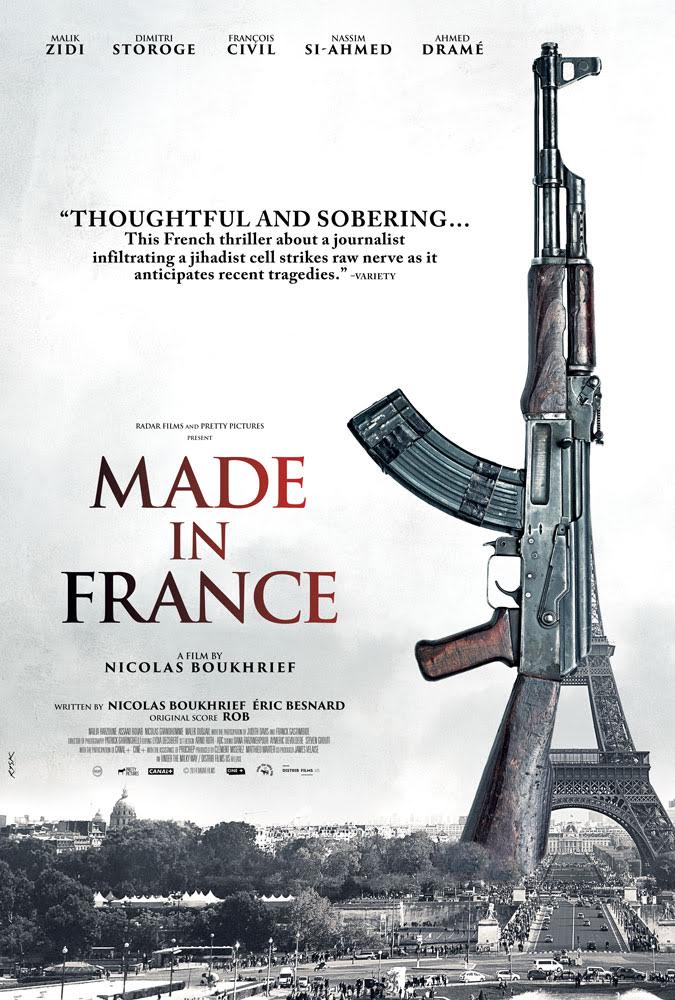
Home-grown terrorism, French-style, in Nicolas Boukhrief's thriller, MADE IN FRANCE


Although made in 2014 and released (in France) in 2015, the new thriller/melodrama MADE IN FRANCE, co-written (with Eric Besnard, of the glorious Ca$h) and directed by Nicolas Boukhrief, appears mostly to be, as they say, "ripped from recent headlines" -- particularly those regarding home-grown terrorism in full swing. The film is an effective look at terrorism from several angles: journalism, anti-terrorist law enforcement, and the terror cell itself, as well as from the POV of all the various characters caught up in this hugely troubling scenario.

M. Boukhrief, shown at left, does an excellent job of compressing time, information and character into a sleek 89 minutes of fast-paced storytelling, in which we meet a journalist named Sam (Malik Zidi, shown below, and recently seen in The Assistant) who has managed to involve himself covertly with a terrorist cell in which, before he can extract himself or alert the authorities, he suddenly becomes a functioning (and violent) part. This unfortunately leaves him open to blackmail by those authorities who need him to remain under-cover to help them prevent further atrocities. The slippery slopes here grow greasier by the moment.

Cast exceptionally well with actors who seem quite right for their roles (and fill them to the brim), the movie functions as exciting entertainment, as well as a heavy-duty and all-too-timely warning about the threat of fundamentalism gone increasingly haywire.

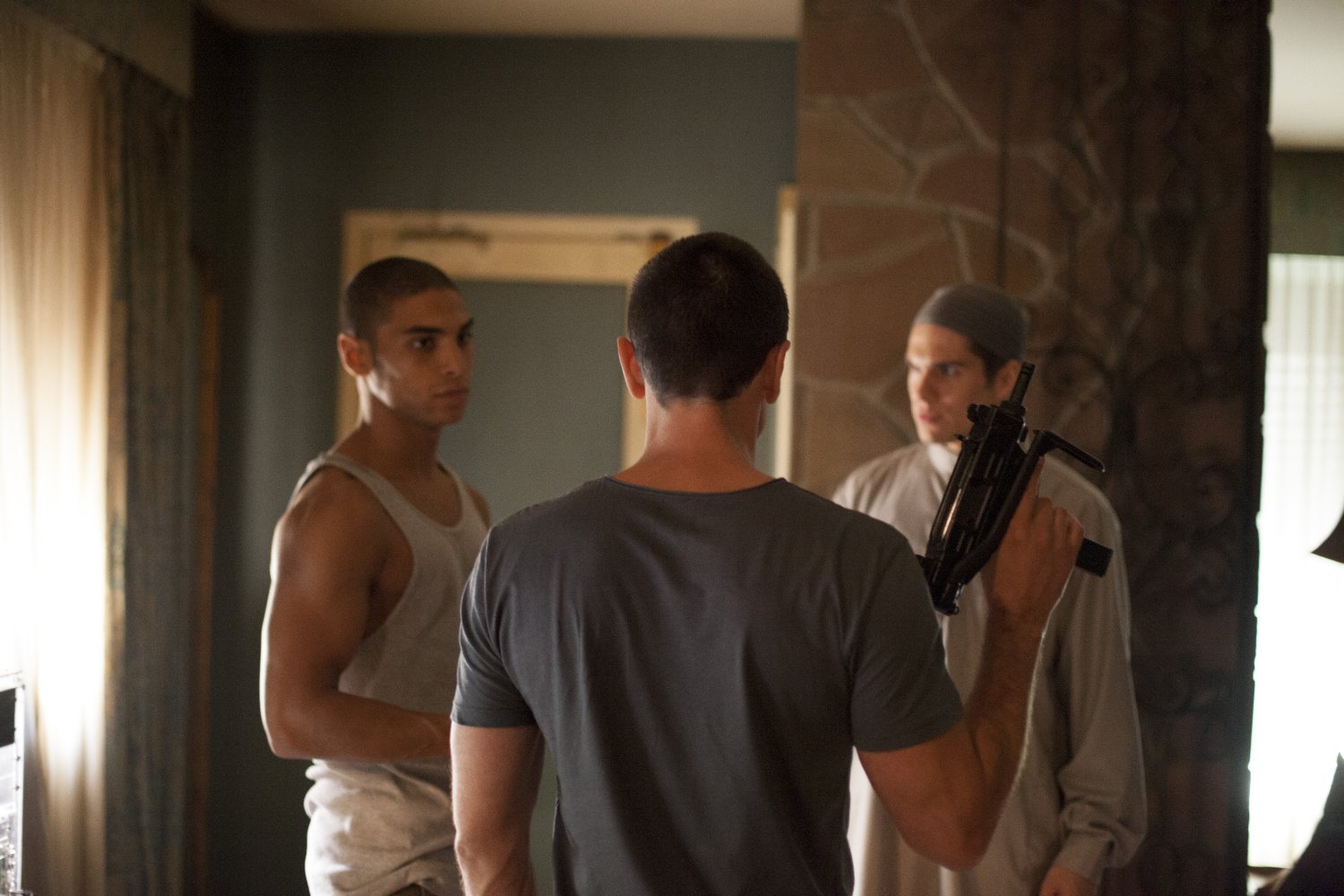
It also allows us to see the varying standpoints of these "brothers" in arms (above), as well as that of their frighteningly insistent leader (played with intense strength and a certain reserve by Dimitri Storoge, center left, above). Their differing beliefs control the thinking and functionality of these men, and as those beliefs are of varying depth, they make the actions of our guys, and therefore the tale being told, full of small surprises that add increasingly to the complications on view.

The distaff side is represented by the beauteous and striking Nailia Harzoune, as the woman belonging to the cell leader, and this character proves pivotal to what finally takes place.

If the movie sorts itself out a little too conveniently, at least it does so with finesse and excitement, leaving us to ponder anew the prospects of both widespread group-terrorists acts in our western nations, as well as those simple-but-deadly, one-off jobs.

From Distrib Films US and Under the Milky Way, Made in France will make its debut, tomorrow, Tuesday, December 13, on all major VOD platforms in the United States, including iTunes, Google Play, Amazon, Comcast, Charter, and Vudu. 

Sunday, December 11, 2016

December Sunday Corner with Lee Liberman -- THE CROWN: Smoke and Mirrors


"Oils and oaths, orbs and scepters, 
symbol upon symbol, an unfathomable web 
of arcane mystery and liturgy
no clergyman or historian or 
lawyer could ever untangle.
Who wants transparency 
when you can have magic? 
Who wants prose 
when you can have poetry? 
Pull away the veil and 
what are you left with? 
An ordinary young woman of 
modest ability and little imagination. 
But wrap her up...
anoint her with oil 
and presto... a Goddess!"
....as spoken by Alex Jennings, 
playing The Duke of Windsor, 
former King Edward VIII, 
The Crown, Episode 5, "Smoke and Mirrors"

So be thou anointed, blessed, and consecrated in the name of the Father, the Son, and the Holy Ghost.... Thus began the unexpected reign of Queen Elizabeth II, 'Defender of the Faith', sworn not by a member of the judiciary or the government but rather anointed by Anglican clergy. The visual montage commencing each of The Crown's 10 episodes is of molten metal pouring, sliding, and congealing into filagreed golden regalia (crowns and such) -- images that, along with a sweeping score, plunge you into the royalty thing with timeless grandeur.

Although 'Divine Right of Kings' mostly disappeared itself with Enlighten-ment thinking in the late 18th century, English ceremony would have you attribute god-like qualities to the ruler -- that is how Elizabeth was raised and instructed by her family, her prime ministers, and secretaries. No longer woman, wife, mother she is now answerable to God, submitting her will to monarchy. This had the effect of tying Elizabeth to the past like the Pope, and the Anglicans are almost as slothful as Rome. In this treatment both the Queen and Philip know that church and state must be separate, but always dutiful, she has complied with church authority.

Peter Morgan (shown above), screenwriter of this lavish and complex undertaking (Netflix paying a reputed 100 million for 20 episodes) does not let the royals off lightly. The Queen survives crises at her own and her family's expense; she rules with equal resolve and regret, her composure barely masking discomfort. The excellent Claire Foy (Wolf Hall, Upstairs, Downstairs, Vampire Academy) bears the burden of all this show. We see the young Queen and her dashing naval husband, Philip Mountbatten (the quirky Matt Smith of Dr. Who) struggle mightily to navigate a marriage in which the spousal relationship could not be more upside down from the mores of the 1950's.

Philip, naval commander and great-great grandson of Queen Victoria, has his hopes dashed of continuing his career when father-in-law, George VI, died young. Resentfully putting up with perceived indignities, he knelt before his wife at coronation, paced behind her in public. His children would be named Windsor not Mountbatten. Philip squirms, chafes, and gripes. On a world tour designed to buck up the image of British Dominion, he exclaims that the royal pair are the coat of paint; 'waving like lunatics, a circus trudging from town to town like dancing bears'; or this: 'my work is as a navel officer -- not grinning like a demented ape while you cut ribbons'. He wakes from dreams with his arms in the air -- waving. However, Philip has soldiered on and been a modestly effective populist force for modernization. (Was all that contrariness a desire for progress or pique at the diminution of his own patriarchy?)

A divorce meme percolated through the lives of the Windsors, bookending the first 10 episodes. Edward VIII ( David to his family) became king in January 1936 and abdicated late that year to marry his paramour, twice-divorced American social climber Wallis Simpson, thrusting his shy, stuttering younger brother, Elizabeth's father, on the throne as George VI. Ending the series is the story of her sister, Princess Margaret (Vanessa Kirby), who fell in love with her father's equerry (assistant), Peter Townsend (Ben Miles), also divorced (both, 2 pictures below). Margaret was stopped first by the Cabinet and finally by the Queen, her hand forced by church dictates -- divorced parties with living ex-spouses were not welcome at court until 2002.

The abdicate-king, retitled Duke of Windsor, is a snide observer of the monarchy and his royal relatives (see quote at top). The disgraced pair (above) lived abroad after abdication becoming "society's most notorious parasites...while they thoroughly bored each other". (Wrote Wallis, "You have no idea how hard it is to live out a great romance.") The Duke visited England alone where his mother, Queen Mary, shamed him and he's spurned by his niece the Queen, her mother, and church authorities. All blame him for shirking his duty to rule, causing, they think, the early death of his brother, King George VI (an addicted smoker -- need one say more) and robbing the young Elizabeth of a simpler life out of the spotlight. Morgan reimagines considerable pain spread around as he deploys family resentments.

Gelignite perfectly titles the episode about Princess Margaret's love affair with Peter Townsend that exploded like a bomb in the press, not the least due to Margaret's flamboyance and the vanity of Townsend. Elizabeth, wishing happiness for her sister, makes promise after promise to the couple, but as she wades deeper into the labyrinthine reality of realm, she is forced to go back on her word (below, sisters at odds). If Margaret takes Townsend she will be forced into abdication like their uncle. The repetition of her Uncle David's humiliations was more than Margaret could take.

Some have described Elizabeth as jealous of her sister's popularity and her recall of Margaret from the spotlight as spite; I saw Elizabeth as duty-bound to preserve the proper order of things ("since the crown has landed on my head"), including the sacrosanct image of the royal family. She tells her lively sister: "...the monarchy should shine, not the monarch."

The depth of the emotion aroused in 'The Crown' surprises, since we know the story. One's satisfaction in this mini-series (and two other good ones: Parade's End and Wolf Hall) is not about 'what happens' but the emotional experience and interior lives we come to share with the protagonists --moments of daily life 'pinned to the page' (a phrase of Hilary Mantel, author of the "Wolf Hall" novels) . Here we know fear, pain, and maturing resolve of the Queen, humiliation and acting-out by Philip, hate and loss in the Duke of Windsor, and the despair of Margaret (whose premature death was also smoking-related). "Uneasy lies the head that wears a crown" (Shakespeare).

We share interiority with one other major figure in 'The Crown' -- aging PM Winston Churchill, brilliantly acted by our own John Lithgow who shrinks height but not moral or physical weight as he comes to life. Churchill mentors his Queen, crafts his moments in the limelight (below he's staged a late arrival to Elizabeth and Philip's wedding), manipulates his subordinates, and confronts aging and illness. Ach, the humiliation! Lithgow was genius casting. Churchill also offers example of a relentless visual through the 10 episodes, an enemy of golden regalia, that is tobacco smoke streaming unnoticed, poisoning the mightiest among them.

"The Crown" is in my view a complete triumph of drama; its sumptuous beauty balanced by the dreary tedium, hypocrisy, and vapidity of royal duty -- all that smoke and mirrors. The archaic and mystical connection to the church may reach back to Alfred the Great, for whom the church was the repository of learning, law, and order -- at that time bright hope in dark medieval Europe. But in a modern world of civil order, one wishes that English monarchy could reinvent itself without fake holiness. Would its role vaporize?

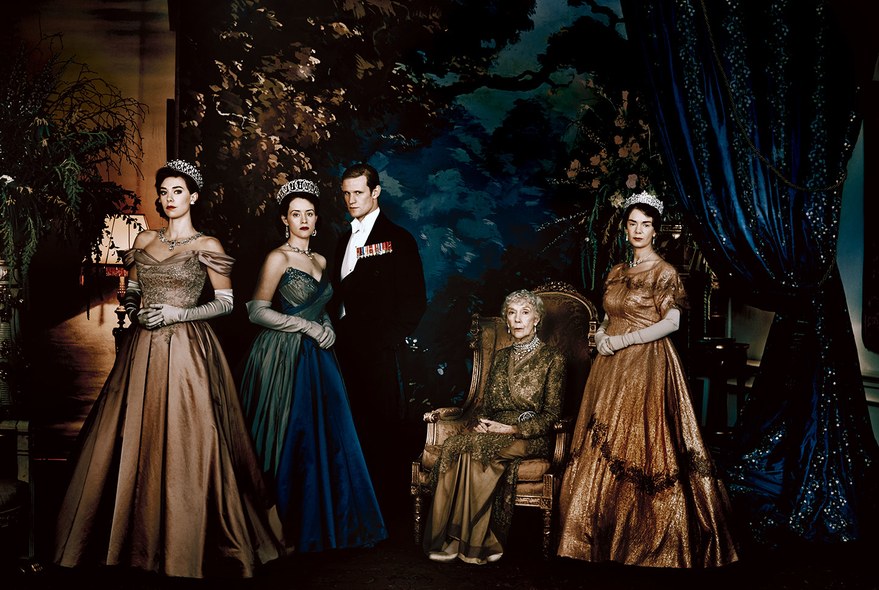
A small note: the casting and acting is close to flawless, with minor exception. Jared Harris (above r), a fine actor, still could not make me suspend disbelief because he looks so unlike King George VI (above, l) no matter how well Harris plays death's door from the opening scene. Greg Wise (Mountbatten) has the Windsor look. The small girls who played young Elizabeth and Margaret were perfect, easy to picture growing up into the adult sisters. At any rate, for anyone into modern royalty, "the Crown" is 5-Star worthy. Below, from l, Princess Margaret (Vanessa Kirby), Queen Elizabeth (Claire Foy), Prince Philip (Matt Smith), Queen Mary (Eileen Atkins), Queen ''Mum" Elizabeth (Victoria Hamilton).

Overheard at Downton Abbey, 
via Violet, Countess of Grantham: 
"You Americans never understand 
the importance of tradition." 
Mrs. Levinson: "Yes we do; 
we just don't give it power over us.
Maybe you should think of letting go of its hand." 
...from Season Three, Episode One 

Life's but a walking shadow, 
A poor player 
 That struts and frets his hour upon the stage
And then is heard no more. 
It is a tale 
 Told by an idiot, full of sound and fury, 
 Signifying nothing.  
...from Macbeth by William Shakespeare 

The above post was written by our 
monthly correspondent, Lee Liberman