Tuesday, January 23, 2018

What a surprise! Sam Hoffman's intelligent, satisfying generation-gap/old-age comedy, HUMOR ME


Down here in South Florida, we get perhaps more than our share of senior-citizen movies opening in local theaters. And why not? That's where we seniors do tend to congregate. So it comes as almost a shock when one of those movies -- in this case, HUMOR ME, written and directed by Sam Hoffman -- turns out to be a real winner: smart, often surprising, written, directed and acted with skill and flair, and above all else genuinely funny. What is particularly oddball and amusing about the film is how (and how well) Mr. Hoffman uses old-fashioned (but still funny) jokes -- both the telling of them and the visual creating of them via the use of black-and-white cinematography (think of those 40s film noir) -- as both the entry-way into and the very theme of his movie.

Never forget, the writer/director (pictured at left) seems to be telling us throughout this little low-key gem, exactly how important a good joke can be. He and his film prove this in spades. Humor Me is the tale of a blocked (in many ways) middle-aged playwright, Nate Kroll, given terrific life by that fine New Zealand actor, Jemaine Clement (above and below, right, of What We Do in the Shadows and People Places Things), who manages to be funny, sad, schlocky, sexy and lots more while always utterly believable. When events suddenly coalesce to the point where our hero has nowhere else to go, he must move into the rather upscale and not unpleasant retirement village in New Jersey with his dad (played in unusually reticent and quite smart fashion by Elliott Gould, at left, below and on poster, top).

Once there, Nate meets a whole raft of interesting and often funny characters, brought to life by as good a cast of seniors as has been assembled in quite some time. Better yet, Mr. Hoffman gives them all enough character and wit to make them fun to be around. While the filmmaker deals with the usual cliches about the elderly, he manages to turn enough of them on their ear so that we laugh and eagerly follow along.

Smartly, Mr. Hoffman has created an inter-generational movie, rather than merely one about seniors, and the middle-aged adults here get to shine as brightly as do the aged. Nick meets the daughter (Ingrid Michaelson, above) of another senior on premises and even gets roped into "directing" a very mini-mini version of The Mikado (below) -- the result of which provides the movie with its absolutely delightful, refreshing and very funny climax.

Yes, OK: This is not great movie-making in any regard. And yet, when compared to some of the really awful stuff we've been subjected to down here over the past couple of years that TrustMovies and spouse have been living in Florida -- Silver Skies and Year by the Sea come immediately to mind --  Humor Me seems very nearly Oscar-worthy.

With supporting roles filled ever-so-nicely by actors such as Priscilla Lopez (second from left, above), Rosemary Prinz (center right, above), Le Clanché du Rand (second from right, above) and Willie C. Carpenter, the movie fairly zings along on its humor, heart and smarts. A word must also be said for actor Joey Slotnik, who plays Zimmerman, the subject of all the movie's black-and-white-photographed jokes. He, like so much else here, is a consistent delight.

From Shout Studios and running just 93 minutes, Humor Me -- after opening in New York and Los Angeles a week or so back -- hits South Florida this Friday, January 26, in Miami at AMC Aventura, in Fort Lauderdale at The Classic Gateway Theater, The Last Picture Show in Tamarac, Regal Shadowood in Boca Raton and at The Movies of Delray  To view all currently scheduled playdates, cities and theaters, click here.
Humor yourself and go see this one.

Monday, January 22, 2018

The "guaranteed basic income" debate gets another hearing in Christian Tod's smart German documentary, FREE LUNCH SOCIETY


Oh, yes: Here we are yet again back at the old let's-give-everyone-a-guaranteed-basic-income proposition. Turns out there is still plenty to say in favor of this, and -- after a slow beginning that seems to diddle around with only a partial guaranteed income --  the new documentary by Austrian economist and filmmaker, Christian Tod (shown below) entitled FREE LUNCH SOCIETY puts forth a damned good case for bankrolling such a "crazy" plan.

Beginning (and ending his film, too) with Patrick Stewart in a scene from one of those later Star Trek TV episodes, Herr Tod moves to some interesting history: President Richard M. Nixon, of all people, was in favor of such a scheme, but Ronald Reagan, then governor of California, was not and helped sandbag any congressional efforts toward this. Overall and down the decades, certain conservatives, progressives, even Libertarians have been in favor of this -- from Milton Friedman and Charles Allen Murray to Martin Luther King (shown below) and Frances Fox Piven (further below). So the idea is certainly more "bi-partisan" than one might initially imagine.

Perhaps in order to try to coax us gently into all this, Tod offers up Alaska and the manner in which, thanks to the benefits of oil exploration, the state was able to give back to its citizens a certain amount of "free" money each year. Certainly not nearly enough to live on, the income was still greatly appreciated.

As the documentary moves along, however, we grow closer and closer to what could be an amount actually large enough to live on -- frugally, it must admitted, but that's certainly OK. We look at some of the "experiments" here in the USA (usually halted in mid-stream or prior to their even getting under way) toward this goal -- in New Jersey, Seattle and Denver -- and understand, finally, that this idea is less about the distribution of money than it is about the distribution of power. The idea of "rent-seeking" by our current corporations is brought home, as well, and this may be something many of us had not previously thought about in this manner.

Along the way we hear from entrepreneurs such as Götz W. Werner (above) and learn more about Switzerland and even of what the African country of Namibia has attempted along these lines. Much of the film is absolutely thought-provoking and bracing, particularly as regards human behavior and the old caveat that guaranteeing an income will deprive the people of their will to work. We get some fascinating ideas about the citizenry, too -- for instance, how our current power structure prefers us to be consumers rather than responsible and informed citizens.

Finally the film explores the idea of technology and who really benefits from its advancement. As statistics have now proven time and again, it is not the labor market that benefits but those who control capital. This must change.  All ready now...?

From Icarus Films, in English and German with English subtitlesand running 92 minutes, Free Lunch Society is available now on DVD -- for purchase and (I hope) rental.

Caleb Carr's long awaited transition of THE ALIENIST makes its TV debut on TNT tonight


From the time of its 1994 publication, Caleb Carr's notorious novel The Alienist was said to be on track for a major motion picture. And why not, as it would seem to have just about everything going for it? Set in New York City during The Gilded Age and peppered with real-life characters (Teddy Roosevelt), as well as the usual fictional ones, with a tale of a serial killer who preys in particularly vicious fashion on child prostitutes (both boys and girls), it had just about every "hook" in the book -- from transgressive sex and pedophilia to uber-violence, guts and gore, all wrapped into a lovingly detailed "period piece."

Finally and nearly a quarter-century later, THE ALIENIST arrives -- if not on the "big" screen, at least on your TV screen -- in a ten-part series that, from the first two episodes we critics were sent for review, captures the above "hooks" in all their ugly, tawdry glory. In fact, though the series is set in that "gilded age," we spend so much time in the 1890s slums, brothels and filthy streets of New York City that you come away from those initial episodes remembering mostly the grime and dirt, rather than any opulence you might have viewed.

The "alienist" of the title refers to the term used back then to describe what we would now called a psychiatrist. Our alienist is one, Dr. Laszlo Kreizler (played with his usual skill and charisma by German actor Daniel Brühl, shown above, center). Surrounding him are two other major characters, Sara Howard (Dakota Fanning, below) a pretty, young, up-and-coming suffragette from a very good family who works in the office of Mr. Roosevelt, and talented artist John Moore (Luke Evans, above left) who is able to capture the desecrated corpses of the victims with unusual skill and realism. Both these characters will assist the good doctor in his off-the-record investigation.

These characters, as written and performed, are perfectly acceptable but not too much more than that. Instead -- at least in those initial episodes --  it is some of the subsidiary characters who pack the most punch. In particular, we have the young doctor brothers, Lucius and Marcus Isaacson (played by Matthew Shear and Douglas Smith) -- Jews, and so definitely outsiders in this time and place-- who bring some welcome humor, energy and charm to the proceedings.

The Alienist is dark and ugly indeed, so you'll need to gird up your loins and grit your teeth while viewing this one (unless, of course, dark and ugly is already your cup of tea). But over the entire enterprise hangs a kind of "manufactured" quality. I recall feeling this, too, while reading the novel, and so stopped midway and never finished it.

The television version of the novel does have the added impact of coming now, when so many of the problems from that Gilded Age -- the enormous "wealth gap" to the ever-popular "we-hate-immigrants" movement -- are timely all over again. I would certainly watch at least a few more episodes of the television series, as it is visually interesting and well-acted enough to pass muster. But finish it? I don't know. We'll have to see....

From TNT, The Alienist begins tonight at 9pm EST. Good luck! (That's Brian Geraghty, above, as the series' version of Teddy Roosevelt.)

Sunday, January 21, 2018

Special "event" screening alert: Phil Grabsky's art-and-artists documentaries to open at various venues (see final Personal Appearances paragraph below)


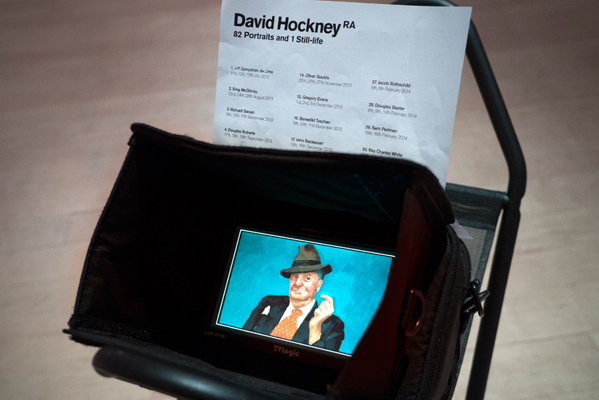
Fans of popular British artist David Hockney (there are many of these worldwide) will not want to miss the new documentary, DAVID HOCKNEY AT THE ROYAL ACADEMY OF ARTS, which pretty much brings us up to date on the work of this 80-year-old-but-still-going-strong artist, tackling especially his most recent shows at the Royal Academy of Arts in London. The 80-minute film, directed with sprightliness and the expected visual flair by noted documentarian, Phil Grabsky, is a most pleasurable and easy-going treat that concentrates almost totally on Mr. Hockney's art, unlike other Hockney films seen over the past decades -- A Bigger Splash (from 1973) and Hockney (2014), to name but two of many that journey into his life and private life, as well.

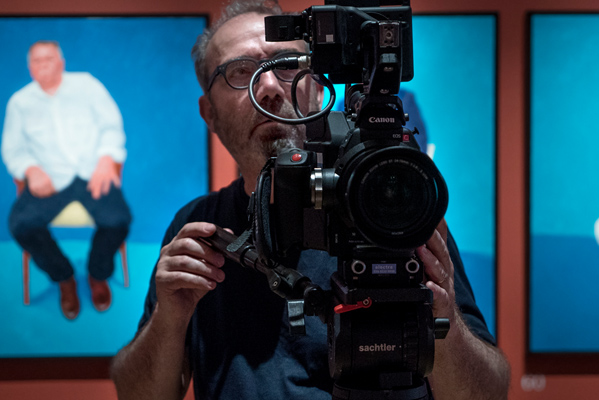
Mr. Grabsky, shown at right, offers up reams of examples of later Hockney art, along with talking-head interviews with art critics/authors who fill us in on the importance of Hockney and his art.

As one of these experts points out, Hockney (shown below and at bottom) was one of the most important artists who helped bring figurative art back into prominence, after the ascendance and too-long reign of the non-figurative stuff we used to call "modern art." As usual we see, again and again here, this man's great gift for color and composition, along with his own special skill in producing art that seems at once improvised and yet distilled into a kind of near-perfect resolution.

Another critic notes Hockney's combination of honesty, bravery and willingness to continually experiment -- "I don't mind boring others, but I'm not gonna bore myself! --  while yet another critic notices some early paintings whose subject matter seems "darker" than the usual Hockey work. "No," the artist corrects him. "I just used cheap paint." He was both younger and poorer back then, and the cheap paint used has led the canvas to darken over time.

The movie is full of Hockney's vaunted honesty, intelligence and wit. Mostly, though, it's full of his more recent art -- which is as beautiful and as much fun as ever. We learn that a good friend, who was dying at the time, brought Hockney back to England and then to painting landscapes once again. How much more lush are his British landscapes, as compare to his work in the dryer and more arid Southern California scenes (even with that Bigger Splash in the picture)!

We see an entire room full of his series, The Arrival of Spring in Woldgate, and also learn how and why he has begun to divide his painting via grids. Eventually we see the remarkable series of portraits shown at the Royal Academy of Art entitled 82 Portraits and One Still Life that it must have been museum-heaven to experience live.

We also learn more of his technique -- we see the quick charcoal drawing that first appears, followed by the fill-in of detail and color -- and finally get a sense of what might come next in the career of this continually busy and productive artist.

From Exhibition on Screen and running just 80 minutes, David Hockney at the Royal Academy of Arts is playing now at various venues around the country. To find the city and screen nearest you, simply click here and follow directions. (In South Florida, the film will screen at The Society of the Four Arts in Palm Beach on Sunday, February 18.)


Personal Appearances!
Director Phil Grabsky will be in USA this coming week (March 25 through April 1) to host a tour of exclusive Q&As for a selection of EXHIBITION ON SCREEN films – starting with the up-coming release in the US: Cezanne – Portraits of a Life.  Below are links to each of several appearances around the country, including here in Boca Raton.

Sunday 25 March, National Gallery of Art Washington, Cézanne – Portraits of a Life 

Monday 26 March, Avalon Theatre, Washington DC, Canaletto & the Art of Venice – at The Queen’s Gallery, Buckingham Palace

Tuesday 27 March, MOVIELAND BOULEVARD SQUARE, Bow-Tie Cinemas, Richmond Cézanne – Portraits of a Life

Wednesday 28th March, Paramount Theatre, Charlottesville Cézanne – Portraits of a Life

Thursday 29 March, A/perture Cinema, Winston-Salem The Artist's Garden: American Impressionism 

Saturday 31 March, Society of Four Arts, Palm Beach, I, Claude Monet

Saturday 31 March, Living Room Theaters, Boca Raton I, Claude Monet 

Saturday, January 20, 2018

DVDebut: Taron Lexton's IN SEARCH OF FELLINI proves (very) light on the Fellini


Can a movie get by almost exclusively on charm and visual beauty at the expense of any kind believable story line? Prior to seeing IN SEARCH OF FELLINI, the first full-length film from South  African-born Taron Lexton (below), I would have thought this pretty doubtful, but after viewing his said-to-be-based-"mostly"-on-a-true-tale movie, I've got to admit the film works well enough to garner an OK rating.  As gloriously shot by Kevin Garrison in Verona, Milan, Rome and Venice, Italy (oh, yeah -- and in Ohio, too), the cinematography is often so breathtakingly beautiful that you'll be swept away long enough to forget, or maybe just ignore, the rather saccharine and unbelievable tale told here.

As written by Nancy Cartwright and Peter Kjenaas, that story is one of a young girl (played in adulthood by the very lovely Ksenia Solo, below), so pampered and secluded from real life by her mother (Maria Bello, shown at bottom, right) that the poor thing is completely unsuited for autonomous adulthood. So what does she do? She leaves her dying mother to head for Italy all by her lonesome and there to somehow meet her new hero, famed filmmaker Federico Fellini, whose movies she has suddenly discovered via a Fellini festival in her home town. (The film takes place a couple of decades back, as Fellini died in 1993.)

Too dumb to get to Rome where the filmmaker resides, she ends up in Verona, then Venice, before finally arriving at her real destination. But that's all to the good because, along the way, she and we get to view a raft of fabulous locations and also meet and fall in love with what must be the sweetest and most handsome straight male in all of Italy (Enrico Oetiker, below, with Ms Solo).

But onward she must go toward Signore Fellini, and so she also almost gets raped-while-being-filmed by a nasty hunk named (against type) Placido. Not to worry, despite its R rating, this is a feel-good movie par excellence, so when our heroine finally does encounter her hero, it is in perhaps via the most gorgeously lit and filmed restaurant scene in movie history -- with no dialog yet, so that we can instead imagine what is being shared by the two.

Yes, indeed, this is all so silly that it would defy belief -- were it not so lovely to look at. All the leads are super-attractive, and Italy, well, come on: You know how visually enchanting that country can be. So I would suggest placing you brain on hold for the film's 103 minutes and just giving yourself over to its many visual pleasures.

Inter-cut into the film are many moments from the real Fellini catalog. And while Mr. Lexton's work apes the master's, he has filmed his movie with mostly gorgeous actors, while Fellini preferred much more bizarre-looking casts. Both filmmakers give us fantasy based on reality. The master created his films from someplace deep and humane, while Lexton, whose view may be prettier, offers up what might best be called Fellini-light.

From Spotted Cow Entertainment and running 103 minutes, the movie -- after hitting VOD and digital outlets last month -- reaches DVD this coming Tuesday, January 23.

DVDebut for IN HER NAME, Vincent Garenq's drama of death and much-delayed justice


Less a revenge thriller than a quiet and compassionate drama of loss, anger and a search for justice, IN HER NAME, the 2016 French film by Vincent Garenq and starring the exceptional Daniel Auteuil, is a tale taken from life that spans several decades but compresses these into a smartly conceived, directed and written (by Garenq, shown below, and Julien Rappeneau) movie that lasts but 87 compelling minutes that are definitely worth a watch.

A true-life tale that made news in its native France, the movie tells of the Bamberski family -- husband (M. Auteuil), wife (Marie-Josée Croze, shown two photos below) and their two children -- torn apart by the wife's continuing infidelity with a family acquaintance (his daughter is a schoolmate/friend of their daughter) who is a successful doctor in Germany and who proves to be a swine of the first order. This character, who exists mainly as the significant "villain," is  played with a near-perfect combination of charm, sex appeal and sleaze by German actor, Sebastian Koch, shown below, left, with Auteuil.

The story -- which begins with the arrest of M. Bamberski by French authorities (we're unsure of exactly why, although kidnapping has been mentioned) -- then backtracks some 30 years to Morocco and then France, Germany, and back again, as events unfold in a continuous time-line made up of relatively short scenes that show us what is happening and why.

Although these events involve things such as rape, untimely death and maybe murder, Garenq avoids any heavy melodrama by keeping his film to more of a documentary style (and I mean that in the old-fashioned, not the newer, hybrid, sense of the word). He doesn't try to jolt us or turn his movie into a suspense thriller. He doesn't need to because the events themselves are awful enough, and what happens after the initial death proves even more jarring and anger-provoking. The filmmaker has chosen to tell his tale in what turns out to be the most appropriate way possible.

Garenq's other ace-in-the-hole is his leading actor. M. Auteuil has for decades now proven his command of the screen in his own generally quiet fashion. He can on occasionally go over the top, too, and either way stealing films from under other heavier-handed actors like Gérard Depardieu (remember The Closet) without even trying.

Here his quiet determination is both believable and occasionally chilling. He's an obsessive, all right, but as someone who has lost his daughter, first to her betrayer and then to the French and German justice systems, how could he not be? Auteuil holds the film together and brings it home. His final line, in fact, is as simple, honest and heart-breaking as you could want.

The supporting cast (made up mostly of characters trying to help Bamberski achieve his goal) is also spot-on, with Christelle Cornil (above) especially good as the new woman in Bamberski's life who tries her best to join in/put up with his obsession.

Out on DVD from Icarus Films and streaming from Distrib Films, In Her Name, in French with English subtitles, is available now -- for both purchase or rental.

Thursday, January 18, 2018

Nikolaus Geyrhalter's CERN finally gets an American release -- from Icarus on DVD


Made back in 2013, prior to Nikolaus Geyrhalter's later and better documentary, Homo Sapiens, but only now getting a release (on DVD) here in the USA, his eponymously-titled film about that famous research center in Switzerland where they are trying to understand and/or maybe re-create the Big Bang, CERN is interesting enough but it also seems lacking when compared to the terrific documen-tary, also made in and about that research center, entitled Particle Fever.

Herr Geyrhalter, pictured at left, has made a number of first-rate films I would not under any circumstance have wanted to miss, and while I am glad to have seen CERN, I would call it one of his lesser works in that it does not possess the depth, surprise or subtlety of his others. It is what it is -- a 75-minute exploration of the research center and some of the very smart scientists who labor there --  and that's perfectly OK. Perhaps because this documen-tary (according to the IMDB at least) was made for television, it seems an unusually simplistic example of Geyrhalter's oeuvre.

The filmmaker inter-cuts between scenes of physicists, engineers and researchers (as above) explaining to us non-scientists what they do and shots of what we might call the grunt workers (as below) doing the physical labor at CERN, who for whatever reason don't get the chance to speak with us. The higher-level speakers do the best they can explaining to folk like us who haven't much of a clue to this kind of science or research. (One fellow here almost continually chuckles and laughs as he talks, probably because trying to give us a elementary-school level understanding of his job is so ridiculous).

The film is full of Geyrhalter's usual gorgeous cinematography which is always a pleasure to view, and although the speakers here seem to come from all over the globe -- Italy, Germany, Africa, France, the USA and more -- English (being the one clear international language) is constantly spoken, albeit as the first speaker we hear tells us, it is very broken English because everyone speaks it with a different accent. English subtitles would have helped the film tremendously, given that, by the time you have managed to decipher a new and different accent, you've also missed half of what was being said.

Still, and aside from what you might be able to learn about what's going on at CERN, there is also some fun to be had hearing the little bits of gossip you'll pick up. There are lots of divorces here, one woman explains, probably because of how dedicated these scientists are to their work above all else.

After spending much of the film underground we at last see the natural light of day for a bit before returning below. CERN, it turns out, is like a small city with literally thousand of "citizens" to be governed. The place has its own fire department and police force, too. You'll learn this and a lot more, and even if you can't quite perhaps understand all of what you're being told, you'll come away from this relatively short documentary feeling, I suspect, that CERN is probably the absolutely smartest spot on earth.

The film concludes with one of Geryhalter's marvelous tracking shots in which we glide down a corridor for what seems like forever until... yes, the film simply ends. From Icarus Films, running 78 minutes, in broken English and featuring about one dozen interviews, CERN is available now on DVD for purchase and (I hope) rental.