Thursday, December 19, 2019

Catching up with a little-seen gem from 2017: Galinsky/Hawley/Beilinson's ALL THE RAGE


I've been interested -- and a good deal more than just that -- in the work of the filmmaking team of Michael Galinsky, Suki Hawley and David Beilinson even since seeing their phenomenal activist documentary, Battle for Brooklyn back in 2011 (it was shortlisted as an Oscar contender that year). But I am late in viewing another of their films -- ALL THE RAGE -- that made its debut at DOC NY in late 2016 and was released theatrically in very limited fashion in 2017.  The documentary tries -- and to a good extent succeeds -- in putting us in touch with the groundbreaking work in the field of what we might now call "pain management" by the late Dr. John Ernest Sarno.

Sarno (shown above), who died in 2017 just one day short of his 94th birthday, originated  the medical term tension myositis syndrome (TMS), his name for a psychosomatic condition of repressed feelings (often rage, hence the film's double-edged title) producing chronic pain, particularly in the areas of the back, neck and limbs. Shunned by the medical establishment, Sarno nonetheless practiced his art for decades curing thousands at the famous Rusk Institute in New York City, where founder Howard Rusk was firmly in Sarno's corner, even if, once Rusk left the Institute, no one else there would recommend either Sarno or his work.

Galinsky, who has been helped through his back pain by Sarno, set upon making a film that tries to explain as much as possible Sarno's theory -- even if, as this documentary also makes clear,  each patient must wrestle with that theory, come to understand it, and apply it to him/herself. A few of the famous and celebrated who have done just this -- to pain-free results -- are Howard Stern (above left), Larry David (above, right) and John Stossel, the latter of whom did a now-famous 20/20 episode on the good doctor.

The filmmakers -- Galinsky (above left) co-directed and did the cinematography, Hawley (center), co-directed and edited, and Beilinson (at right) co-directed and produced -- weave together a history of pain, pre-Descartes to present-day, while interviewing Sarno, some of his patients, and others in the medical profession who do agree with his groundbreaking work. The result is a film that fascinates, even if its objective always seems to remain slightly out of reach. What you're likely to take away from the movie is: If you're in need of pain help, read Sarno's book and go from there. Which you may very well do, so genuine and real seems everything about Sarno -- who consistently appears to be smart, intuitive and sanguine -- and his theory.

The documentary is also a hugely personal work. During the filming, Galinsky has a horrible recurrence of back pain, which renders him practically immobile for a time, and we not only feel the filmmaker's pain but some real embarrassment at his having been caught in such a vulnerable light. Oddly enough all this simply adds to the documentary's overall effect of tantalizing us without quite being able to satisfy.

And yet, satisfy, it does, finally. I would not have missed the movie, and I hope you will have the opportunity to see it, as well. As one noted physician, Dr. Gabor MatĂ©, tells us toward the end of the film, it is "despite the evidence, not for lack of it, that we practice (medicine) the way we do." Around the time the film devotes itself to the U. S. Senate Committee on Health, Education, and Pensions as part of a 2012 hearing "Pain in America: Exploring Challenges to Relief" -- chaired by Senator Tom Harkin, who himself experience back pain relief via Dr. Sarno, with Senator Bernie Sanders (above) also part of this hearing --  you'll probably be ready to share this one-of-a-kind documentary with any of your friends or relatives experiencing chronic pain.

So where can you find All the Rage?  Purchase a DVD or stream the documentary for rental by clicking here. Then feel free to share this link -- and the film -- with your friends.

Tuesday, December 17, 2019

Highly recommended: Nikolaus Leytner's dark, faux-feel-good THE TOBACCONIST, a tale of the rise of the Nazis in pre-WWII Vienna


Searching for something dark and different? Look no farther than THE TOBACCONIST, the movie co-written (with Klaus Richter) and directed by Nikolaus Leytner, adapted from the popular novel by German actor Robert Seethaler.

From the outset in the gorgeous Austrian countryside -- as our 17-year-old hero stays underwater far too long while his mother has noisy, outdoor sex with the fellow who's semi-keeping her, after which her lover is electrocuted as he goes for a swim during a lightning storm -- the movie takes on the look, tone and feel of a fairy-tale fable gone somehow quite awry.     

Herr Leytner (shown at right) and his co-workers succeed in holding that tone, look and feel for the entire movie, even as the story told begins to look more and more like a lovely coming-of-age rom-com. Don't hold your breath, as the place (Vienna) and time period (the rise of Adolf Hitler and his Nazi party) preclude just about anything resting in the realm of the positive.

When our hero, played with a winning combination of naivete, rampant sexuality, and burgeoning idealism by Simon Morzé (below, right), meets the girl of his dreams Emma Drogunova, below, left), she turns out to be a Bohemian lass who has been, not merely around the block a few times, but very possibly around the entire city.

Likewise, when mom -- now deprived of her major source of income, must ship her son off to the big city to meet and work for the father (who, till now, he's never seen nor even known existed), this man -- who lost a leg during service in WWII and now owns a successful tobacco shop frequented by some wealthy clients -- turns out to be a veritable role model. "Dad" is played very well indeed by Johannes Krisch, below.

Performance-wise, however, the movie's ace-in-the-hole is that fine Swiss actor Bruno Ganz (below, right), who died earlier this year, after giving one after another memorable performances (from The Marquise of O and The Wild Duck to Wings of Desire and In the White City). Here, in one of his final roles, Ganz plays, yes, Sigmund Freud, who happens to be a client of the tobacco shop, takes a liking to our young hero, and helps him out with everything from his dreams (they are weird and many) to his love life.

Novelist Seethaler's choice to set his coming-of-age tale against a time and society fraught with such ominous, overriding negativity gives his narrative a kind of constant tension, as well as darkness not usually found in the genre. Hope fights with despair, light battles shadow, ideals butt brutal reality. Given the time and place, we should not be too surprised at the outcome.

And yet all this is handled with enough subtlety and even some surprise that we are swept up and away all over again. And if the darkness wins out, it does so in the hands of filmmakers and a cast that weave their own dark, sad and quite special spell.

From Menemsha Films and running 108 minutes, The Tobacconist makes its North American theatrical debut in Toronto this Friday, December 20, at the Mount Pleasant theater. Elsewhere? Sure hope so, but U.S. cities and theaters have not been announced as yet. Stay tuned and click here for periodic updates.

Sunday, December 15, 2019

December Sunday Corner With Lee Liberman: THE CROWN, SEASON 3 -- 1964-1977


There was a young lady from Dallas 
Who used a dynamite stick as a phallus. 
They found her vagina in North Carolina 
and her asshole in Buckingham Palace. 

Imagined not real, the limerick, above, that the screenwriter put in the mouth of Princess Margaret at a White House party in 1965 did the trick: At a lavish dinner party hosted by the Johnson’s for the Snowdon’s, Margaret wooed our president in vernacular they both enjoyed, getting Lyndon to agree to the British government’s plea for a U.S. bailout during an urgent financial crisis. Johnson had been refusing PM Harold Wilson’s calls (the Brit’s weren’t backing his war in Vietnam). But following Margaret and Tony’s visit, the ‘special relationship’ went from cool back to sure-footed. Her thrilling success didn’t widen Margaret’s sphere of influence at home as she was regarded as a bomb-thrower best kept on the down-low. Peter Morgan says he made up what happened at that dinner, but it was so like the principals, one can only wish it did, and pity poor Margaret — the little ‘vice queen’ with an applause deficit.

Morgan’s marvelous Netflix series continues with vignettes that are smaller than the drama of the world war era but absorbing. Here is Britain during the middle years of the Queen (now played by Olivia Colman of The Favourite), the young adulthood of Prince Charles and Princess Anne and the Snowdon scandals. One feels a tad sorry for the Windsors— the ruthless scrutiny and humiliations visited on this ordinary family living under glass.

The royal porn may pay for itself despite the schadenfreude and outright rejection it brings on itself, fed by the soap-opera tales of their private lives. The Windsors function with great success as a soft-touch but powerful PR firm — the outcome of the Crown’s search for meaning as it evolved from ruling monarchy to figurehead. Many royals work full time dutifully promoting civic and social causes. The self-imposed rules they live by assure that duty and kindness are quite, if not perfectly, constant; the Crown ‘firm’ functions as parent archetype, committed to useful work and maintenance of the public image. (Prince Andrew, having embarrassed himself in an unapologetic interview about his ties to Jeffrey Epstein, has just been cut from the firm’s public face upon the intervention of Prince Charles, it is reported, asserting himself as monarch-to-be.) Maybe the US could profit from more do-good, apolitical authority.

The salacious chapters have some nuggets. We learn new about the origins of Charles (Josh O’Connor, Only You) and Camilla (Emerald Fennell, below). Camilla’s relationship with Andrew Parker-Bowles (Andrew Buchan) was more passionate than imagined in which they used others to make each other jealous, involving Charles and an acerbic Princess Anne (well-acted by Erin Doherty) who joined the quadrangle “for a bit of fun”. Lord Mountbatten and the Queen mother then broke up the party, instigating Camilla’s marriage to Parker-Bowles while Charles was on Naval duty. (No wonder he would later defiantly flout his marriage to Diana.) Much more domestic nastiness appears in the chapter about the affairs of Tony Snowdon (he who winsomely charmed the Queen to secure her favor) and Princess Margaret precipitating the deterioration of their marriage — splashy tabloid fodder then, soap-opera now.

It’s not all soap. A KGB spy is discovered living in the Palace and there are labor troubles. Prince Philip, splendidly acted by Tobias Menzies (Game of Thrones, Outlander; click here to read a fine interview with the actor), has a mid-life crisis coinciding with the US moon landing and visit of the astronauts to the palace. The Prince, a pilot himself, unhappily sidelined from adventure, waxes in awe of the young astronauts until he meets them, drippy with colds, having nothing of awe to report beyond the lists they had to tick off as they worked through their mission. Philip doesn’t get that ‘meaning’ is all in the doing — the action of climbing the mountain not getting to the top. Menzies (below, l; Prince Philip, r) conveys Philip’s emotions with such self-restraint, he has made himself the stealth star of this ensemble.

A chapter is devoted to the passing of David, Duke of Windsor (Derek Jacobi) living in exile in France and shunned with his notorious wife Wallis (Geraldine Chaplin), for whom he abdicated the throne. Again, Morgan ignores the elephant in the room — the pair’s unholy infatuation with the Nazi’s that led to their non-grata status, making government quietly grateful that divorced American Wallis kept David from the throne. Perhaps a different screenwriter at a different time will dramatize that juicy story.

Crown - 3’s most memorable episode may be the mining incident at Aberfan in 1966, a tiny Welch town that suffered a tragic coal-debris slide. After days of rain, a tip (little hill) of coal debris sank, sliding downward and across the street, burying the town elementary school. It killed 144 people, most of them kids. PM Harold Wilson, Prince Phillip, and camera-slung Tony Snowdon went to the scene at once but their description of the horror and the PM’s urgings could not convince the Queen to go — it fell to rogue Labour party members to induce her late visit. Labour threatened to blame the Queen and prior Tory governments who had ignored reported dangers at the mine site. Several lines of copy on the screen report that the Queen’s failure to go at once to Aberfan remains a matter of deep regret to Elizabeth, and that she has visited the town often in intervening years.

Another chapter shows us the character of the monarch-in-waiting — that is the story of Charles’s Welsh language and history instruction prior to his investiture as the Prince of Wales. The Welsh, especially his local university tutor, anticipate the chore with derision, only for Charles to win them over with sincere, earnest effort. Charles is well-conveyed by O’Connor, who conjures him quite completely (O'Connor below r, Prince Charles l)


At end, Crown 3 was as entertaining as earlier series, supporting Morgan’s stated goal to use the monarchy as a canvas for this decade or so of the latter 20th century, all the while laying out a good gossip. Full cast replacement helps his case, as you focus less on individuals and more on the unfolding stories of the era.

At left, screenwriter, Peter Morgan and his partner, Gillian Anderson, who will appear in the next edition of The Crown as Margaret Thatcher.


The above post was written by 
our monthly correspondent, Lee Liberman

Friday, December 13, 2019

Blu-ray debut for the under-appreciated George Roy Hill/Stephen Geller adaptation of Kurt Vonnegut's SLAUGHTERHOUSE-FIVE


Back in the 60s and 70s, when TrustMovies endured his late-coming-of-age period, Kurt Vonnegut was one -- maybe the --most favored novelist of those of us in or near the boomer generation. I think his work holds up pretty well, and so does the movie version of one of his most popular and enduring novels, SLAUGHTERHOUSE-FIVE, directed by George Roy Hill (shown below, an Oscar-winner for The Sting and a nominee for Butch Cassidy and the Sundance Kid), with a good screenplay that follows the book well yet not too slavishly from Stephen Geller.

What might seem missing from the movie -- this being but an adaptation rather than the original -- is the peculiar, particular Vonnegut tone. For instance, the refrain that echos through the novel, So it goes, is nowhere to be found in the film. Not literally, and yet Hill and Geller find their own right tone that carries through their movie so that So it goes -- which you can interpret as icy irony, a kind of capitulation, or perhaps an acceptance of things as they are rather than how you might like them to be -- is there in the film without ever having to be spoken aloud. Via the manner in which this movie builds and coalesces, this now famous phrase seems absolutely part and parcel.

Slaughterhouse-Five is a combination time-travel sci-fi/philosophical treatise novel, and it works equally well as both. One of the things that Hill and Geller get right and handle extremely well is the constant zipping back and forth from past to present. This is so quietly and subtly managed that audiences back in 1969 may have been unprepared for something this skillful. Even today, some 47 years later, it seems fresh.

The movie also brought to filmgoers' attention a new actor named Michael Sacks (above), who then and now seems a perfect fit for Vonnegut's based-upon-himself-as-a-young-man hero. Sacks never had a long nor hugely memorable career in films but his performance here in the role of Billy Pilgrim was about as good as could be.

The supporting cast includes the late Ron Liebman (above, center), nastily impressive as usual, and a luscious and sparkling Valerie Perrine (below), along with a host of fine character actors, all doing some of their best work.

Although I saw the film when it first came out, watching it again became a new experience. Yet as much as I was enjoying it, Slaughterhouse-Five seemed as though it lacked a certain depth and raison d'ĂŞtre as it moved along. Then, around three-quarters of the way through -- the point at which Billy's explanation of the philosophy of the time tripping Trafalmador coincides with the burning of the corpses found after the WWII fire-bombing of Dresden, for this viewer at least, the movie took on the profundity that the novel sometimes reached.

And from that point until the spectacular, moving, charming and funny finale, Slaughterhouse-Five did indeed seem wonderfully profound, finally serving up a philosophy by which one might profitably live. (That's fine character actor Eugene Roche, above, right, as Billy's mentor, protector and best friend during his time as an American POW in Germany.)

From Arrow Video (distributed here in the USA via MVD Visual/MVD Entertainment Group) and running a mere 104 minutes, the movie hit the street last week in a pretty good Blu-ray transfer -- for purchase (and, I hope, rental).

As usual with Arrow product, the Bonus Features are well worth watching. The best here is a lovely, smart, and very entertaining interview about/appreciation of the film with author/critic Kim Newman, as well as a interesting present-day interview about the filming and how he came to this film by Perry King (who plays Sacks' son in the film; in real life, the two actors were the same age, but the make-up department did a fine job in aging Mr. Sacks in surprisingly believable fashion, considering what was possible back in the 1970s).

Wednesday, December 11, 2019

Stream this year's Christmas hit: John McPhail's ANNA AND THE APOCALYPSE


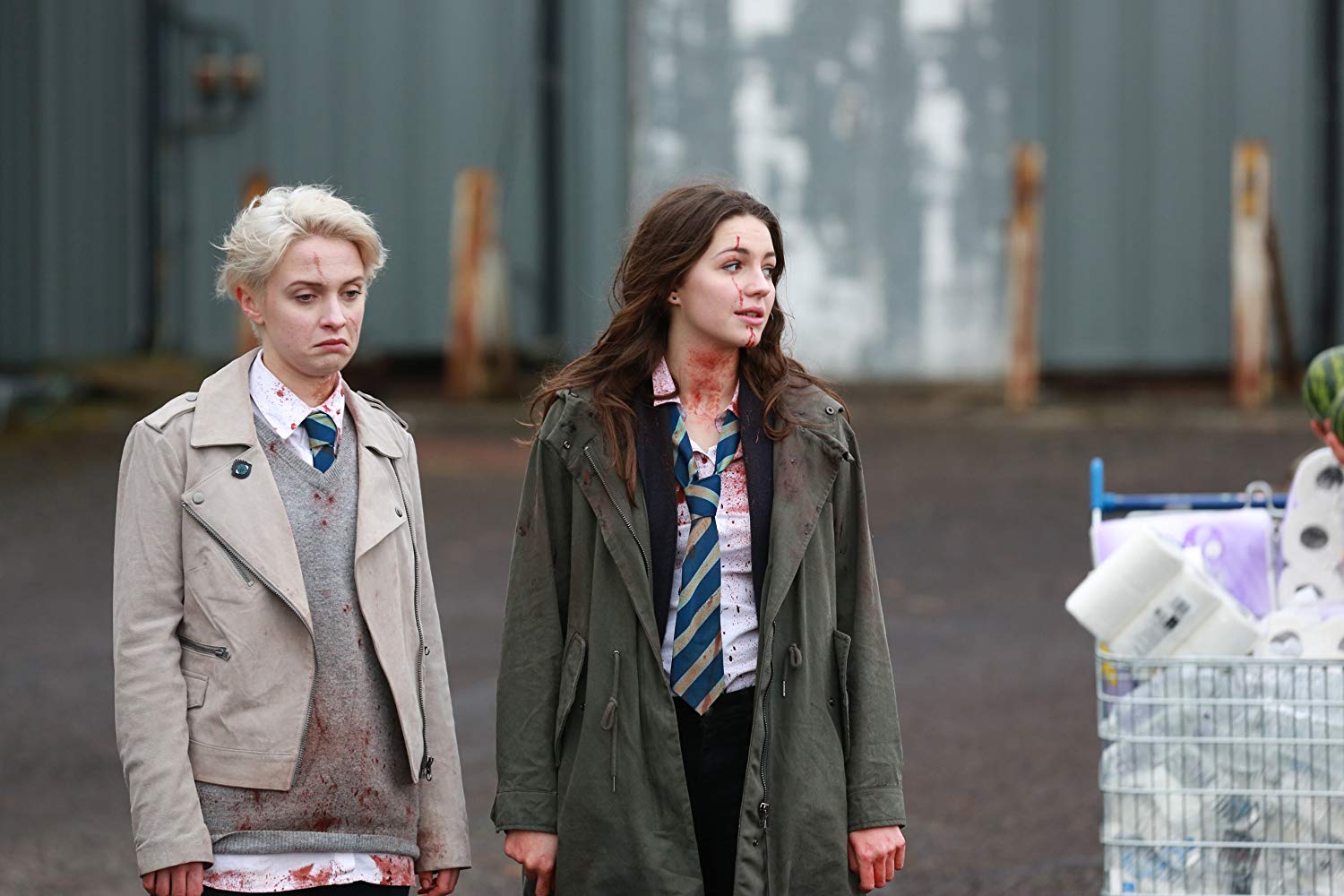
Likely to become a holiday classic -- thanks to its delightful and original combination of high school musical, zombie pic and Christmas movie -- ANNA AND THE APOCALYPSE snuck into theaters in limited release at the end of last year (garnering some very nice reviews in the process) and is now available to stream via Amazon Prime. The movie's a winner, a keeper, and an all-round wonder as it unfurls its very charming, funny and bizarre "take" on high school, love, friendship, Christmas pageants and zombies. Really, this is the best zombie movie since Train to Busan and the best original musical in several years (for my money it beats the too-precious La La Land all to heck).

As directed with a remarkably intuitive sense of tone and tenor by John McPhail (at left) and co-written -- with not just exceptional "smarts" but also an appreciation of and love for the genres they send up and add to -- by Alan McDonald and the late Ryan McHenry (to whom the work is dedicated), this little film finds its footing so quickly and securely that I suspect film buffs will recall it fondly and lovingly when many other more trumpeted, high-budget movies will have long faded from memory.

The story is simple and initially rather sweet. As Anna and her loving dad drive along the highway discussing Anna's future (for which they each have a different plan), on the radio we hear, "The CDC has announced that what it initially thought to be a contagious--", at which point Anna switches the radio off, and we continue with high school and teenagers, the trauma of growing up, falling in love (of course with the wrong person), and putting on the yearly Christmas pageant. Talk about a pointed but relatively subtle manner in which to introduce the expectation of zombies -- and then having the chutzpah to simply leave them offscreen for quite some time!

By the time we do see them, Anna (Ella Hunt, above center) and her friends are so immersed in teenage narcissism and song (a lovely, funny one, too) that they don't even notice the undead cavorting in their slow, zombie fashion behind them. (These zombies adhere to the better, slower George Romero version, which allows for a lot more leeway, escape routes and fun.)

Anna's friends include her "bestie," John (a sweet Malcolm Cumming (above, center), who clearly loves Ella in more than a best-friend way, and student investigative journalist Steph (no-nonsense Sarah Swire, at left, below),

and especially the school bully, Nick (Ben Wiggins, below), who turns out to have a bit more on the ball than bullies in other films. Wiggins also gets a great song midway along that reinforces how cleverly Anna and the Apocalypse plays with the genre conventions of zombie movies, high-school rom-coms, Christmas movies and so much else.

The supporting cast is terrific, too, with Paul Kay, below, left, as the succulently sleazy school headmaster, and Mark Benton, below, right, the very picture of a kindly, loving, over-protective dad.

Who survives and who does not may surprise you, and this certainly adds to the film's thrills and sometimes to its sadness. (As one of the songs tells us, "There's no such thing as a Hollywood ending.") I can't remember when a zombie movie made me laugh and touched me in the way this one does, yet even the moving moments don't seem too sentimental. They're all delivered with a wit and a style that seduce. (Who'd imagine a Christmas candy cane as a prime zombie-killing tool?)

Marli Siu (above) makes a sweet secondary love interest for the school's nerdy-but-nice photographer, a funny, on-the-mark Christopher Leveaux (below, center left). The musical numbers range from very good to OK, with more of the former than the latter, and they are produced and executed so well that they seem utterly organic to the rest of the film. In a movie that mashes this many genres, that took some doing.

Oh, yes, there's gore, too. This is a zombie film, after all. But even the blood is handled with the same kind of smart tone and subtlety as all else here. Boy, what a special little movie this is!

Streaming now via Amazon Prime, and also available for rental or purchase on DVD and Blu-ray, Anna and the Apocalypse is simply too good to miss. It'll take its place with other fine, dark Christmas movies, for folk who need a respite from the current feel-good holiday twaddle filling our network TV, cable and streaming services.

Monday, December 9, 2019

Piling it on: home video debut for Jen Tullock and Hannah Pearl Utt's BEFORE YOU KNOW IT


We often hear that "theater people" are crazy but, really, several of the characters found in BEFORE YOU KNOW IT just about reach the point of insufferable.
This wobbly concoction, about a family of theater folk who live above the small New York City theater they also own, begins with Mandy Patinkin playing the most insufferable of the entire bunch, a playwright who won't allow a word of his precious verbiage to ever be changed. When he departs early from the film, you'll probably breathe a sigh of relief. Hold on, though; things don't get much better.

The film stars a pair of actresses -- Hannah Pearl Utt and Jen Tullock, shown above, left and right respectively -- doing double and triple duty here as director (Ms Utt) and screenwriters Ms Tullock and Utt again). Utt plays Rachel, the supposedly dowdy but smart sister who of course holds the family together, while Tullock, as Jackie, who is dumb, blousy as just about as insufferable as her dad. She also is the mother of a near-shockingly normal daughter named Dodge (played by Oona Yaffe, below), who, as the single, vaguely non-insane family member, pretty much steals what's left of this near-intolerable movie.

Ms Utt plays Rachel using almost a single hangdog expression. It has its charm, for awhile, but come on now. However, even this is better than Ms Tullock's loud, crazy, mostly ridiculous outbursts that begin to defy credulity early on and only grow worse as the movie progresses. I swear you'll soon want to throttle her. How this family could leave Dodge in the care of an accountant they may not even know (of course, he turns out to be a fabulous, standup guy) is one of those idiot wonders of present-day screenwriting (and, no, don't tell me this is screwball comedy time).

Before You Know It posits that the siblings' mom, long thought dead, is alive and well and starring in some famous TV soap opera. That she is played by the fine actress Judith Light (above) ought to offer hope. But, no: Ms Light has rarely been seen to less advantage.

Aside from some dumb would-be sibling rivalry and an utterly clueless therapist (Alec Baldwin, below) the film concentrates on manipulating us and its plot into a typically desired but totally undeserved happy ending. Along the way there is a funny/sad and nicely-done section regarding Dodge's first menstruation, and thanks to the editing, music, and the occasional correct tone when the writing and performances come together, the movie has its moments and seems to almost work (an audition scene in which Patinkin's dead dad reappears, and how this flows into the following scene, for instance).

Content yourself with what you can and be grateful that your own mother was probably a hell of a lot better than anything you see or hear here. From 1091 and running 92 minutes (my spouse gave up at the point of 43, but TrustMovies soldiered on), Before You Know It hit "early purchase" EST on home video last week and will be available via VOD tomorrow, Tuesday, December 10 -- for purchase and/or rental.

Saturday, December 7, 2019

Pair of Fritz Lang's late German films -- THE TIGER OF ESCHNAPUR and THE INDIAN TOMB -- make Blu-ray debut


Fritz Lang "completists" are sure to want to include this (for the most part) very good Blu-ray transfer of two of his last films made in Germany, once the director had tired of filmmaking in Hollywood and returned to his home country, after the Nazis had been defeated (and/or relocated to South America, the USA and elsewhere).

The place of Herr Lang (shown in portraiture/caricature at right) in filmmaking history seems pretty secure to TrustMovies, and so, when I say that these two later films are not particularly good, this certainly should not take away from the fellow's work (Metropolis/M, earlier in Germany; Man Hunt/The Big Heat, while in Hollywood.

THE TIGER  OF ESCHNAPUR together with THE INDIAN TOMB -- available this coming week on Blu-ray in a new two-disc set, with some nice Bonus Features -- should certainly find their way into the collection of Langophiles, particularly those who must have everything. For the rest of us, however, we may watch and watch and find ourselves wondering if maybe the filmmaker's style, as well as his intelligence, had partially deserted him.

The pacing is snail-like, with exposition poured upon more exposition until, as with so many soap operas, you could miss an episode and not have missed anything at all. One the plus side is an extravagant budget (for its day and for post-war Germany), with India seen in much of its glory in a Blu-ray transfer that is quite good, for the most part.

Unfortunately, the first of the films, The Tiger of Eschnapur, is by far the weakest, with the titular tiger(s) the best thing in the movie. German star Paul Hubschmid, as the hero, is rather wooden, but American actress Debra Paget (below) as the temple dancer/love interest proves beautiful and a decent enough actress to somewhat counteract her co-star. Better yet is Walther Reyer (in royal garb, bottom left) as the initially-nice-turned-nasty Maharajah, full of contradictory impulses.

The movie drags and dawdles until you may find it hard to stick around. If you do, good news: The second film moves faster and is more fun, as our hero and heroine escape the Maharajah's clutches (for awhile). The plot thickens a bit and speeds up considerably, and so The Indian Tomb proves more event-filled -- always a good idea for an adventure melodrama.

Ms Paget gets another dance number with a very fake snake (above) in which she is even more scantily-clad (these dances owe a hell of a lot more to Hollywood than to India), Mr. Hubschmid (below) takes his shirt off, and those gorgeous tigers barely make an appearance at all. But the palace intrigue among family, army and priests does hold our interest, at least.

According to history (and the Bonus Features), these 1958 films were actually released here in the USA in 1960 -- crunched together into a single 90 minute feature (each individual movie was longer than that in its original release!) by American International Pictures. Yet considering how slow and repetitive the movies are, one wonder if this more concise version might not have been the best way to view this Fritz Lang passion project. Sometimes, even Samuel Z. Arkoff knew what he was doing.

From Film Movement, in German with English subtitles and running 203 minutes, The Tiger of Eschnapur and The Indian Tomb combo hits the street this coming Tuesday, December 10 -- for purchase and/or rental. Among the several Bonus Features, don't miss the delightful and informative video essay by Mark Rappaport, Debra Paget, For Example. It's a keeper, even if the actual movies may not be.