Thursday, November 7, 2013

Xavier Villaverde's alert and alluring ANGELS OF SEX explores bisexuality among Spanish youth


Bisexuality, along with the possibility of anything approaching a genuine threesome, is a topic much-loved by TrustMovies but generally avoided by most movie-makers, unless it's tossed into the mix as a kind of hook for transgressive appeal or entry into a character who's -- aha, we knew it! -- not to be trusted. This makes the Spanish film ANGELS OF SEX (El sexo de los ángeles) all the more welcome, then, as it explores, surprisingly gracefully and without judgment, the slow unfolding of a relationship between two young men and the girlfriend of one of them.

Imagine if you can a rendition of The Servant, in which the character played by Dirk Bogarde brings a freeing and positive sexuality to James Fox in his relationship to Wendy Craig, Sarah Miles or, hell, even to Bogarde himself. Crazy, no? Well, that Joseph Losey/Harold Pinter film landed in our laps a half century ago, and though it punched "class division" squarely in the jaw, anything outside the realm of the "normal" sexuality just had to be seen as terrifying and dysfunctional. Xavier Villaverde, shown at left, who directed (and conceived of this new film, along with José Antonio Vitoria) and Ana Maroto (the screenwriter) have concocted a breezy and smart opening involving a group of break-dancers working the street (below) and its audience, in which a pickpocket brings together our two heroes.

Once the two men have met, and it is clear that one of them is quite attracted to the fairly clueless other, it's just a matter of time before sexual attraction plays out, and Bruno (Llorenç González, below), who has never experienced attraction to another male...

...is finding himself torn between the young man, Rai (Álvaro Cervantes, below), who helped him and is now seducing him into feelings and actions he'd never imagined and which threaten...


...to tear him away from his long-time and much-loved girlfriend, Carla (Astrid Bergès-Frisbey, shown at right, an actress possessing one of the most beautiful faces on screen today, and last seen here in the title role of The Well-Digger's Daughter). How the three interact in their dance of attraction, betrayal, sorrow, joy and finally comprehension makes for quite a heady and enjoyable mix of sunlight and shadow. The actors are as attractive as you could wish, and they're quite able to relax into everything and anything that is called for, including bouts of nudity -- though nothing quite full-frontal for the fellows.

The film follows some of the threesome's friends and relations, too, and probes a bit into the love-and-sex habits of the older generation (That's Lluïsa Castell as Carla's mom, above) as well as the younger (her friends, both straight and gay, from the workplace).

Angels of Sex (the original Spanish title is much better: The Sex of Angels -- who are said to be pan-sexual) is so well-executed and believable for so much of its running time that its ending may strike you as too easy and a tad forced.

It works, in any case, mostly because we so want it to work, and I suspect you'll be happy enough to go along. If the movie is not as thoughtful or rich as something like the German 3 (which details the lives of characters a generation older), or as deeply felt and art-oriented as the miraculous 3Some (aka Paper Castles), or finally as truthfully negative about the possible results of a threesome on young people who are simply not ready for it (the French Cold Showers), it remains a film to cherish in an alternative-sexuality sub-genre woefully short on bisexuality.

The movie -- running 105 minutes, in Spanish with English subtitles, and distributed in the USA via IFC Films -- is available now via Netflix streaming, Amazon Instant Video, and on DVD.

Wednesday, November 6, 2013

From the treasure trove of classic, "disappeared" B films: Budd Boetticher's THE KILLER IS LOOSE

Unless you're a connoisseur of Hollywood's B movies of the 1940s and 50s, you might not have noticed that Netflix streaming is offering of late quite a selection of these, some of them I've not been able to find anywhere else. One excellent example of this genre from the late 50s, around the time Bs were beginning to disappear: THE KILLER IS LOOSE, written by Harold Medford from a story by John Hawkins and directed by a guy film buffs will certainly know and love, Budd Boetticher (shown below).

A great watch for nostalgia buffs; lovers of  tight, 50s crime flicks; folk who want the chance to see the voluptuous redhead Rhonda Fleming in black-and-white (many of her films were in color, and why not? Her peaches-and-cream complexion against that red hair: Whew!); or anyone who'd like to view a Boetticher movie that's not a western (the genre he's best-known for) -- if any or all of the above entice, then The Killer Is Loose is made for you. TrustMovies is offering a double dose of poster images this time (see above) -- partly because there are so few decent images available from the film but also to point up how badly designed some of the poster art from the 50s could be. (These were the days when the designer had to pack in an awful lot of information the best he could.)

The film runs but 73 fast-paced minutes and was most likely considered quite violent for its time. (Boetticher knew how to do the most with the least.) Think of this one as kind of police procedural of its time. The tight plot begins with a bank robbery in which not all is as it first appears. When our star policeman (the usual OK work from stolid Joseph Cotton) and his crew accidentally shoot the wife (above) of the robber (Wendell Corey, the  film's stand-out), the already unstable fellow goes full-out nuts -- but in his own quiet, mild-mannered-but-scary way (below).

Within the short running time,  Boetticher and Medford manage to work in the old "I-can't-bear-my-husband-being-a-cop routine, which helps lead to the movie's climax, along with several scenes that give Corey the chance to shine -- making us fear him but also understand where all this is coming from (his wartime service and a history of bullying). If the points scored aren't exactly subtle, neither are they driven home in any overly melodramatic way. This director was too smart for that, which makes so many of his films so surprising and so much fun to view.

One of the movie's best scenes has actress Virginia Christine (above, playing the wife of another cop) giving Fleming's character a good dressing-down for her selfish attitude. One of the later examples of the fine B film that often outshone the A film with which it was paired, The Killer Is Loose is available now via Netflix streaming -- another reason why this very affordable service is currently the best deal going for movie lovers of all kinds (except mainstream, would-be blockbusters).

Tuesday, November 5, 2013

DVDebut today! From Israel, Michael Mayer's OUT IN THE DARK is maybe the best gay melodrama of the millennium

What's it like to be a gay Muslim in Palestine today? As much as I hate the current Israeli occupation of what were Palestinian territories won over in wartime (though one could easily remark that the entire state of Israel was once part of Palestine), watching the disgusting treatment of gay Palestinians by their own people (includ-ing their immedi-ate families) is just about enough to turn one's feelings com-pletely around. The very smart and often thrilling -- tamping up both one's adrenalin and testosterone -- new melodrama, OUT IN THE DARK, from first-time, full-length filmmaker Michael Mayer (shown below) is so well-directed and -acted that it will hold you in thrall from first frame to last. Best of all, it's a crackerjack, dark melodrama that, for the most part, manages to avoid being melodramatic.

The film is also well-written enough to carry you along, though the screen-play is indeed the weak link. Situationally, screenwriter Mayer and his co-writer Yael Shafrir have packed a little too much into the life of one of their protagonists, the Palestinian, Nimr Mashrawi (played by the excellent first-time screen actor Nicholas Jacob, below). Being gay, Muslim and living in the occupied Arab section is enough to get one beaten and even killed, as we see happen  to one of Nimr's friends. Having as well a big brother involved in gun-running and anti-Israeli terrorism makes the young man's life a living hell, as he is soon wrenched between the Israeli security forces and the Arab world's and his own family's crazy fanaticism.

While this makes for very good melodrama leading to a thrilling, pulsating finish, you can't help but realize that the set-up is just a little too neat. Still, so fine are the performances (by all), along with the pacing and technical aspects, that you'll not complain.

The only bit of safety and security in Nimr's life comes from the handsome Israeli fellow, a young lawyer named Roy, whom Nimr meets at a gay bar during one of his infrequent and illegal trips across the border into Israel. Played by a more seasoned actor, Michael Aloni (above and below)...

...who resembles a much-better-looking Anthony Weiner, this character has his own problems -- a mother (Cheli Goldenberg, below, right) who'd prefer he pick an Israeli dick to play around with, and a criminal bigwig client who has promised him a favor (another too-slick bit of plotting) -- but he soon find himself in thrall to his sweet Palestinian.

One of the strengths of the movie is that it allows us to view its protago-nists in various areas of their life: Roy at work and with his family, Nimr with his family and in his role as a budding psychology student working with and for Palestinian social services. From the scene we see in which Nimr helps resolve -- and very humanely -- a situation concerning a men-tally ill mom and her family, it is clear that he'll make a fine counselor.

All this helps round and broaden a film that could easily stick only to its love story and chase/thriller aspects and still be worth seeing. Mostly, though, as it encompasses its theme of justice for Arab gays -- which has rarely been presented more powerfully -- it will leave you ferociously angry at the waste and horror that fanatical religion and backward culture can wreak upon innocents trying to live and love in this world of ours.

Out in the Dark -- from Breaking Glass Pictures and running a near-perfectly-timed 96 minutes -- hits American streets today on DVD, and soon or eventually, I hope, on various streaming formats.

Poetry, the 1950s and a rich lesbian love story: Bruno Barreto's REACHING FOR THE MOON


I'm not certain what fans of the American poet Elizabeth Bishop will make of the new bio-pic REACHING FOR THE MOON. Other than her connection to another American poet, Robert Lowell, TrustMovies knew little about this woman, her poetry or her life and loves prior to viewing the film -- which makes me pretty much virgin territory and thus more susceptible to the beauty and charm of this very well-acted movie that concentrates on what appears to be the major and lengthy love affair of Bishop's life: to the female Brazilian architect, Lota de Macedo Soares.

As directed by the Oscar-nominated Brazilian Bruno Barreto, the film (originally titled Flores raras) is glossy and gorgeous throughout and features two terrific performances from its leading ladies, the Australia actress Miranda Otto (below) and the versatile Brazilian Glória Pires (last seen here in Lula, Son of Brazil). These two women, with their moment-to-moment acting skills that allow us to see their minds and emotions at work in the most immediate-yet-detailed manner make the movie a rich watch whenever they're onscreen, which fortunately is most of the time. (Much of the remainder is worth seeing for the Brazilian flora and architecture, supposedly designed by Ms Soares.)

The women's 17-year affair is a lot to cover in just under two hours, so the movie hits the high points but without too much of the kind of constant, heavy-handed melodrama that can make many bio-pics topple into camp. Because this is a lesbian affair -- taking place in a time when anything except heterosexuality in the missionary position was unacceptable -- the movie offers an added attraction (not to mention the nostalgia factor on full display in the clothes, hairdos and set design).

How these two very different women handle the "forbidden" is also a fine hook: Bishop (American, repressed, and alcoholic to boot) and Lota (above, left: Brazilian, bohemian, wealthy and a something of a control freak) prove a surprise match made somewhere close to heaven -- for a good while, at least. (Descriptions of the film refer to the love affair as tragic, but the filmmaker ensures that the characters and we get a lot of enjoyment out of it.) The scene in which Lota quietly comes to understand that Elizabeth's initial attitude is defensive rather than nasty is so well done that this alone may hook you for the remainder of the movie.

The screenplay is credited to Matthew Chapman (yes, the writer/director of The Ledge!) and Julie Sayres, from an earlier screenplay by Carolina Kotscho, based in turn on the novel Flores raras e banalíssimas by Carmen L. Oliveira, and the final product proves good enough to carry us along and offer occasional pointed and juicy highlights. Elizabeth's sad, heartfelt but honest speech at a gathering after a political coup has taken place is one of these (Ms Otto's fierce intelligence is well-used here and elsewhere in the film).

Another plus is the excellent integration of Bishop's poetry off and on throughout the movie, which should send viewers back to the original work to enjoy and learn more. In the supporting cast, Tracy Middendorf (the blond with baby, above, playing Elizabeth's friend and Lota's lover who brings the two together and then regrets it forever) and Treat Williams (below, right, who has a cameo role as Robert Lowell) are well-used, too.

The musical score (Marcelo Zarvos) is both lovely and unobtrusive, and the cinematography (Mauro Pinheiro Jr.) should do more for tourism than anythng set in Brazil I've seen in a long while. If the film itself can seem occasionally paint-by-numbers, Otto and Pires create character canvases that are wholly original.

In all, Reaching for the Moon proves a story worth telling that has now been told well enough. The movie opens this Friday, November 8, in New York City at the Paris Theater and Angelika Film Center, and in Los Angeles on November 29 at Laemmle's Royal, Town Center 5 and Playhouse 7. You can see all currently scheduled playdates, cities and theaters by clicking here.

Sunday, November 3, 2013

The Rowley/Riker/Scahill documentary DIRTY WARS indicts America's covert, illegal actions

What a surprise and something of a joy it is -- despite the subject at hand -- to see some real investigative reporting hit the screen again. We've had plenty of decent documentaries of late that have tried to ferret out the truth on all sorts of subjects. But TrustMovies surmises that journalist Jeremy Scahill must come from a background of, and thus care deeply about, good solid reporting skills. Watching and listening to the movie DIRTY WARS (based on Scahill's book of  the same name), co-written by Scahill and David Riker and directed by Rick Rowley, is an invigorating experience because of the enormous ground it manages to cover in but 87 minutes, and how Scahill and his crew connect the dots, dot their i's and cross their t's, in the process allowing us discover, just as Scahill did, what is going on -- torture, murder, drone strikes that wipe out families by accident and are then "covered up" -- in places/nations with whom we, the United States of America, are supposedly not at war.

The film-making trio (Scahill is shown above, right, with Riker at left and Rowley, center) take us to various spots where these covert wars are occurring -- Afghanistan (weren't we finished there?), Yemen, Somalia -- during which we watch as our government targets an American citizen and kills him, and then later kills his teen-age son. Yes, this guy was a Muslim cleric who was saying some very anti-American things (hey, so do I, just in case this turns out to be my good-bye). But his teen-age son? Prior to the killing, the man's father tried suing our government to make it stop the "hit." Seeing the grandfather speak now with Scahill should make you not just sad but damned angry.

Scahill (above) understands how to delve. He uncovers evidence of our cover-ups, as well as evidence that wasn't ever bothered to be covered-up, so secure were the assassins in their sense of entitlement, as well as the fact that, well, nobody really cares.

We learn of a formerly secret and still all-powerful group called the Joint Special Operations Command (JSOC) along with the fellow who leads it. Scahill weaves this together particularly well, as the leader appears first here, then there, and finally... well, you'll see and understand. The film, were it not so filled with events that should make you thoroughly disgusted, has enough elements of a mystery thriller to hold you pretty much spellbound.

Viewing and hearing of some of the innocent families (above and below) who've been destroyed -- let's hope purely by accident -- it is quite easy to believe that, as one of the few family members left alive explains, with this behavior, the U.S. is simply breeding new terrorists. I would suggest that this seems to be what we want. We'll need plenty of new ones in order to justify our military/industrial complex's continued demand for constant war, stemming from our need to control ever more natural resources. President Eisenhower would be appalled, while offering an I told you so.

There is so much more to this fine and important film than I have begun to cover here. That's because I am currently away and working remotely and left all my notes from viewing Dirty Wars at home. Apologies. But I hope I've told you enough to entice you to view. It's so easy, too, as the film -- from Sundance Selects -- is now available via Netflix streaming (and elsewhere). If you don't have Netflix streaming, the documentary will be coming back to theaters for a week's run at the Maysles Cinema in Harlem, beginning Wednesday, November 20, through Thursday, November 26, each evening at 7:30. Click here for details.

Photos above are from the film itself, with the exception 
of that of the filmmakers, which is by Natalie Cass 
and comes courtesy of GettyImages.com

Saturday, November 2, 2013

Catching up with an Australian classic: Ted Kotcheff's and Evan Jones' WAKE IN FRIGHT


You've probably heard of this Aussie film from 1971, just as I had. In fact I was certain I'd seen it when it made its U.S. debut. But no -- WAKE IN FRIGHT is a film one does not easily (maybe ever) forget. This is all the more surprising, given that the tale unfolds so simply, naturally, as the "hero" of the movie, John Grant, a young school teacher serving his initial time working in a one-horse-town in Austra-lia's "outback," finishes his last day prior to Christmas vacation and leaves for an overnight stay in Bundanyabba (known to its inhabitants as "The Yabba"), before heading to civilization and a girlfriend in Sydney.

What happens to Grant in The Yabba is shocking all right, but the beauty of the movie -- aside from its brilliant color scheme, cinematography and its gorgeous lead actor, Gary Bond (below, left) -- is how our hero for the most part brings all of this down on himself. The film, written by the very talented Evan Jones (These Are the Damned), from a novel by Kenneth Cook, and directed by Ted Kotcheff (The Apprenticeship of Duddy Kravitz), posits a pretty hateful outback: full of misogynistic, macho (or ocker, as they call it down under) males who appear to live for little else than lager, lust and the occasi-onal Kangaroo massacre.

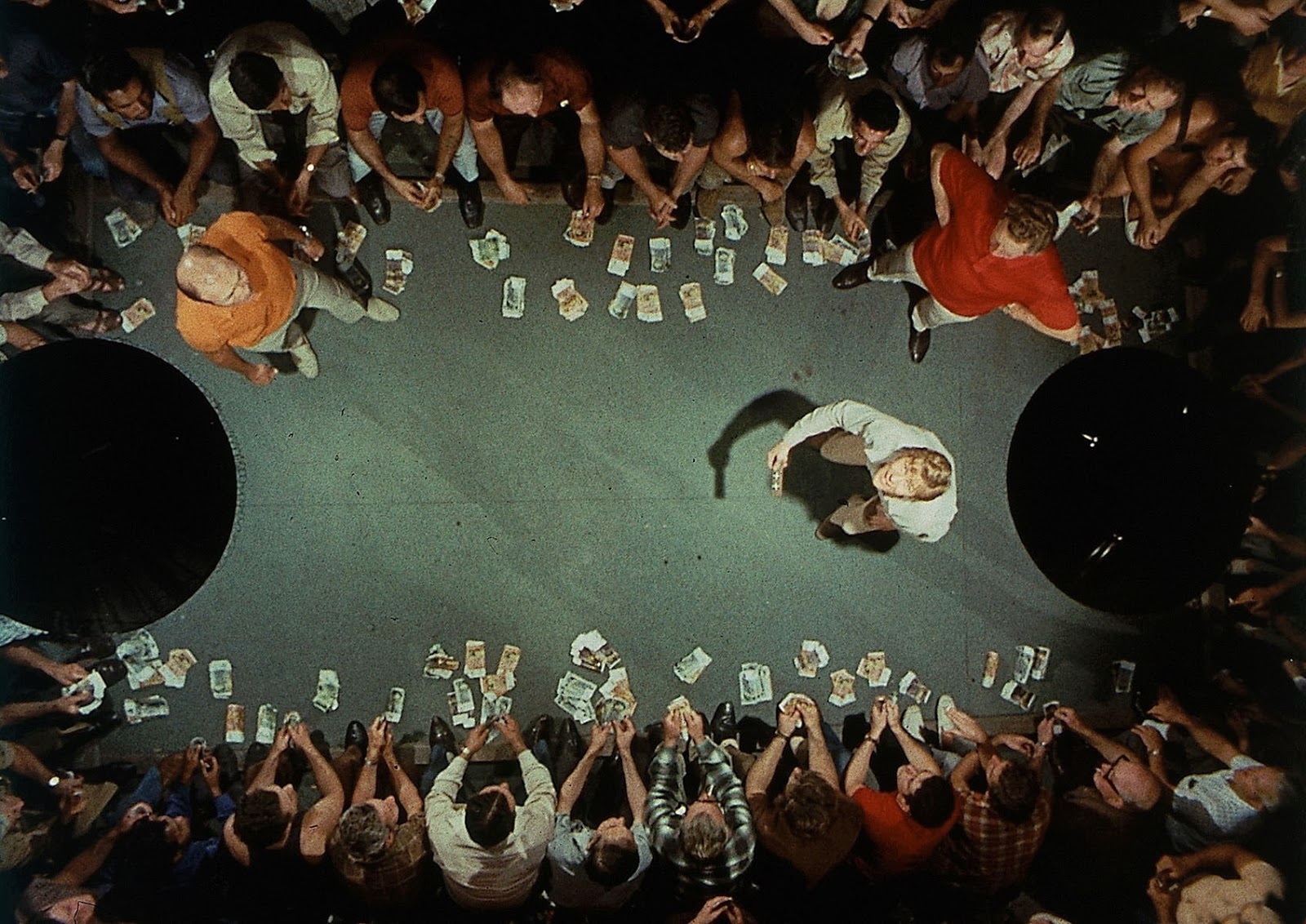
However, if John Grant is to be taken as some kind of example of polite and cultured society, then civilized Australia of that day was untested, snobbish, even a little smarmy. The screenplay's dialog is particularly good: always real and believable, while dotted with occasional smart talk. In this film, the viewer listens as carefully as s/he watches. And the rewards are great. Kotcheff keeps showiness to a minimum, but allows himself some leeway, doing a fine and crazy job of it as Grant goes on a drunken, gambling bender (below). He lets the location -- whether it's a sweat-filled back-room or the tinder-dry outback, overflowing with sunshine and orange earth tones -- create the world we see.

Mr. Bond, his pretty-boy face coupled to a superb body, all of which is on view in one particular scene, is a fine choice as the man who is simultaneously corrupted and humanized. He is surrounded by some of the best talent Australia had on hand back then, along with some more from Britain, such as Donald Pleasence (below), seen here in one of his best screen roles as the disgraced doctor who befriends our hero and opens him up to himself.

Also on hand is Aussie star Jack Thompson, below, seen just a year or two prior to his breakout, along with old-timer Chips Rafferty, playing the Yabba's constable. Best of all the supporting players perhaps is Sylvia Kaye, as the only woman we get close to -- a sad, angry lady stuck forever in what can only be sheer hell for a feeling female.

What makes Wake in Fright -- running 114 minutes in a restoration released theatrically by Drafthouse Films -- truly shocking is how inured these characters seem to all that happens -- as though this is simply par for their course. Trust me: It won't be for yours.

After disappearing from the movie scene nearly since its release, the film has been beautifully restored in high definition, which you can now view in all its glory via Netflix streaming.


Friday, November 1, 2013

Stop and Frisk? Really? Who's stopping and frisking Wall Street & our sleazy banking system?

Yes, yes: I know it's not a movie, but maybe someone'll grab the idea and run with it. All this hoo-haw about stop and frisk and whether or not it's constitutional -- when all along we've been stopping and frisking the wrong guys. Whenever anyone mentions crime, the very first thing that ought to come to mind is: Wall Street and the banks. That's the really unconscionable and still-unpunished crime of our post-millennium (aside from the Bush regime's illegal war, of course).

Instead, at the dropping of the "C word, the first thing out of anyone's mouth is some neighborhood in Brooklyn or the Bronx. Witness the ridiculous interview that New York magazine ran with Mayor Bloomberg last month. At the mention of crime, sho 'nuff, back we go to the neighborhoods and all that puny, individual stuff. And the interviewer, as ever, didn't even raise an eyebrow, as though that was the only kind of crime anybody cares about. Our mayor should be run out of town on a rail for fomenting this kind of shit. Will Bill de Blasio be any different, really? We shall see.

So the next time you hear anybody mention crime, immediately chime in with "You mean Wall Street and the banks, right?" And if Stop and Frisk comes up, tell 'em who it is that actually needs to be stopped and frisked. Don't let the powers-that-be get away with this fakery over and over and over again. Start stopping and frisking the more important criminals now, via some genuine oversight of Wall Street and the banking system -- and just like the Mayor and the Police Department insist, "We'll catch 'em for the small stuff -- and that'll help prevent the big stuff."

I'll be back with more movies tomorrow.