Sunday, November 6, 2016

November's Sunday Corner with Lee Liberman STAR TREK: boldly going--and going and going


"If man is to survive, he will have learned to take delight 
in the essential differences between men and between cultures. 
He will learn that differences in ideas and attitudes are a delight, 
part of life's exciting variety, not something to fear."
- Gene Roddenberry 


Netflix notes the 50 year anniversary of Star Trek, The Original Series (TOS), by its streaming appearance, sparklingly remastered, with approbation on many fronts of Star Trek's value to generations of fans. Created by Gene Roddenberry (1921-1991) TOS ran 1966-69 on NBC. Five more series followed, 13 big-screen films, web sites, Trekkie followers, books, comics, encyclopedia, toys et al (below) -- Star Trek is industry. 

The adventures of the Starship Enterprise in the 23rd century were full of optimistic can-do -- human beings working together to figure things out and fix problems, said first fan, President Obama to WIRED (see the video link at end). Earth belonged to a federation of planets and had cold war foes, but the Enterprise mission was peaceful -- to assist planets in straits or in need of problem-solving.

The half-century milestone is a good point to tally up Star Trek's actual contribution to science and social progress. In all its dated glory it looks and feels like comic book adventure mixed with bible reading -- not for adults as much as select watching with children to help them process current events about war, peace, progress, and human behavior. It's a Roddenberry celebration of infinite diversity in infinite combinations. Original Star Trek took time to catch on. It took a letter writing campaign to get it renewed for a third year. NBC insured its failure in 1969 by cutting the budget and scheduling it when its young audience wouldn't be there to watch. It found its footing in syndication in the 1970's late day thru supper (ritual at my house) and in later series.

Star Trek TOS, our focus here, based its subject matter on the space race, cold war, atomic fear, anger at endless war, dated 1950's social morays, and gender/race inequities; it drew its energy and optimism from JFK's New Frontier, LBJ's Great Society, and confidence in our ability to solve anything. It was a time in American life when it seemed the family of man could unify in Gene Roddenberry's humanist federated world government that would be multi-cultural, interracial, moral, embracing of science, learning, and the spread of freedom. Some of the subject matter was controversial in the late 60's -- tactics were employed to foil the script censors such as pushing boundaries in one area to distract from another knowing the former would be cut and the latter let stand.

The multi-national and-planetary officers of the Star Ship Enterprise ( "wagon train to the stars") and their bonds of affection, irritation, and loyalty led the series to be about humanness as much as science or politics. In the lead was dashing ship's commander, James T. Kirk -- William Shatner, still working in his mid-80's. Pointy-eared First Officer Spock, half-human/half Vulcan scientist from Federation planet Vulcan is much beloved; his emotionless affect steered the crew thru problem-solving with beams of logic -- Leonard Nimoy, actor/director, deceased in 2015. Nimoy/Spock was eulogized by NASA and influential in inspiring space science and travel. Dr. Leonard "Bones" McCoy, was chief medical officer, an emotional Irishman -- DeForest Kelley, died at 79 in 1999. The perpetual heat between Bones and Spock underlined the tension between emotion and logic in problem-solving.

Lieutenant Uhura ('uhura' means 'freedom' in Swahili) put a woman on the bridge at a time black women characters were mostly servants and never real-life astronauts or military officers. Uhura and Kirk had the first U.S. inter-racial screen kiss --Nichelle Nichols is now in her 80's. While Scottish Engineer Scott, James Doohan, is also deceased, two other command crew are busy today: Russian Ensign Pavel Chekov, the placement of whom on the bridge previewed a peaceful end to the Cold War -- Walter Koenig, 80, his parents Russian Jewish emigres, has had a long career as writer, director, teacher, actor; and Sulu, George Takei, 79, is an activist and spokesperson for gay rights and politics, especially as an advocate for former internees of Japanese-American internment camps following Pearl Harbor. His busy life and bits of Star Trek are documented in "To Be Takei" on Netflix.

The extent to which the series imagined our modern high tech era (despite having missed the internet) is described here in a recent article by NASA physicist, David Allen Batchelor, Goddard Space Flight Center, a Star Trek fan, along with colleagues. Batchelor lists the devices familiar to series watchers such as communicator (below), transporter, tricorder, warp drive, cloaking device, replicator, phaser, et al -- describing what came true, is in the pipeline, or is still wishful thinking. His article includes a 1976 photo of the unveiling of NASA's space shuttle named 'Enterprise' in honor of the series and in the presence of many original cast attired in their 1970's bell-bottomed best.

Roddenberry made magic embedding imaginary space tech into plots. In "The Enemy Within", a transporter (used to move crew back and forth between ship and land) malfunction causes Kirk to be both duplicated and divided resulting in one weak captain and the other maniacally strong. Bad Kirk wreaks havoc on board ship while good Kirk grows passive, indecisive. The transporter repaired, the two captains are sent thru and come back as one. But Kirk has seen shocking parts of himself -- his decisive command authority from his dark side (below) and kindness and empathy from the good side. Spock, half-human, half Vulcan, explains he uses his reason to manage his own two warring halves; likewise Kirk must also manage his negative and positive traits to function as their commander.

In "Balance of Terror", Kirk discovers that a string of Federation outposts is being destroyed by a predatory Romulan bird-of-prey ship. The Enterprise attacks, launching a game of wits between well-matched competitors. Kirk finally cripples the Romulan ship, outwitting its captain who expresses regret: "You and I are of a kind. In a different reality, I could have called you friend." Maintaining a 'balance of terror' is offset with regret that one's enemy would be a peer and friend in other conditions.

The original Star Trek offered 79 of these stories on unique planets in weird situations, some frivolous, some badly written, hammily acted, and decorated with silly paper mache props. But many episodes contained some unsubtle nugget of wisdom whether it be about power and its abuse, friendship, empathy for the stranger, the unknown, and the like.

In later iterations of the Star Trek universe, mid-century optimism has struggled, the mood frayed around the edges, no longer suitable for kids but aimed at those who have matured in a world of roiling threat.

It's fitting to end this weekend with mention of the uber-capitalist Ferengi (below) who appeared often in Star Trek series The Next Generation and Deep Space Nine. Writer/producers Ron D. Moore and Ira Steven Behr of Outlander were major contributors to both. Behr, showrunner for DS9, will release a documentary about it in 2017 and he wrote the Ferengi sacred code-- 285 'Rules of Acquisition', the bedrock of Ferengi society. A few of the code's uncanny tenets are: 'when in doubt, lie'; 'once you have their money, never give it back'; 'always exaggerate your estimates', and the formula for the velocity of wealth is 'rate divided by time = profit'.

The Ferengi of Planet Ferenginar were entirely devoted to unregulated capitalism, profit, trade, and swindling of the innocent. Workers benefits were frowned on -- they would interfere with worker exploitation. The Ferengi were unremorseful misogynists; they pressed women into the sex trade. After a Ferengi died he would meet up with the Blessed Exchequer who would dispatch him to the Devine Treasury or the Vault of Eternal Destitution, depending on his net worth. The alt-right Ferengi were too ridiculous to be political threats to the Federation. Likewise our 2016 comic-book villainy now requires similar dispatch to footnote status plus regulation to minimize harm to victims.

It may be that our young, broad-shouldered nation is experiencing adolescent growing pains following our post-WWII late twentieth-century growth spurt and burst of optimism. Original Star Trek offers moral support for the energy it will take to muster new national maturity. Star Trek TOS is not entirely dated after all (the cold war and mini-skirts are back in style); keep a lookout for some kids to share its infinite varieties with.

Note:  In this video, President Obama talks to WIRED about the true meaning of Star Trek....

The above post is written by our 
monthly correspondent, Lee Liberman.

Saturday, November 5, 2016

Rediscovered (again!) cult classic, Leslie Stevens' PRIVATE PROPERTY hits Blu-ray/DVD


Much is being made of the recent theatrical (and now available on DVD and Blu-ray) release of PRIVATE PROPERTY, the 1960 cult classic written and directed by Leslie Stevens, and starring his then-wife Kate Manx, in her movie debut, alongside two better-known actors Corey Allen (from Rebel Without a Cause) and Warren Oates (who was yet to come into full prominence). Supposedly lost and out of circulation for more than 50 years, the film was seen by TrustMovies when it was first released, and then again when it was re-released, either in theaters or maybe on videotape or DVD, at least decade or more back in time.

I cannot recall exactly how or when this earlier re-discovery happened, but I am certain that it did. (Might it have come from a European DVD brought to us via the now defunct Greencine?) Consequently, I greatly question the claim that this is the first time the film will have been seen in all those many years since its debut.

Mr. Stevens (shown at right), whose credits include even more writing than directing, was onto something -- several somethings, actually -- with this film, the first of these being how empty seems the wealthy lifestyle inhabited by the married couple we see here: he, forever trying to make a further buck, and she, so unsatisfied at his constant inattention and patronization. The movie also offers a look at the haves against the have-nots, some of the most voyeuristic scenes seen in a movie up to this time, as well as an enormous undercurrent of homoeroticism that keeping threatening to bubble over into overt homosexuality.

Into the lives of this "model" twosome comes another twosome, a couple of hunky and somewhat frightening drifter buddies -- Duke (Mr. Allen) and Boots (Mr. Oates), who first threaten a gas station attendant to get some free food and drink and then quietly highjack a car and its driver (very well-played by Jerome Cowan) in order to follow another car and its driver, Ann (the lovely Ms Manx) on whom the guys have designs.

For nearly a full hour of its hour-and-twenty-minute running time, Private Property is a slow burner full of longing and hesitation, as Duke comes on to Ann, supposedly setting her up for a sexual rendez-vous with Boots, but also seeming to want to her for himself. All the while, the two men appear awfully close to each other, with Duke joking about Boots just wanting a sugar daddy (which he may, in fact, have already found in Duke). All of this is handled extremely well by both Stevens and his excellent cast, which includes Robert Ward as Ann's thoughtless, thankless hubby.

Although three-quarters of the film is first-rate, the finale descends into full-blown melodramatic-thriller mode, with all the usual conventions and nonsense the genre often includes. While the ending offers a kind of release from what's been building up, it is hugely second-rate compared to the build-up itself. Still, the 4K restoration look great; the jazz score, very "of its time," is appropriate; and Ms Manx (above and further above) looks simply great in her fashions of the day and also does a creditable acting job. (The actress sadly ended her own life just four years later, after making one other movie and three TV appearances.)

The talented Mr. Allen (above) gave probably his best performance in this film -- sexy, scary, charming and even, at times, vulnerable and hopeful -- while Oates (below and on poster, top), in the smaller role, shows plenty of that understated charisma he would demonstrate in many movies to come. With Ted McCord as cinematographer and Conrad Hall on camera, the movie had plenty of talent behind that camera, as well as in front.

This re-release is yet another gift from Cineliciouspics and, having just completed its theatrical run as of tomorrow (you can click here and scroll down to see where it has played), the movie is available now on DVD and Blu-ray, for purchase and/or rental. There is a terrific extra here, too, in the form of a current-day interview with Alexander Singer, the movie's still photographer and technical consultant, who talks about the filming and what went on personally and professionally at the time. It's all fascinating stuff, as is the film itself.

Friday, November 4, 2016

Something different from India: the college-theater fantasia from Kranti Kanadé, CRD


Said to have set the critical establishment of India on its collective ear, CRD -- the new film all about college theater, competition, fascism (or so the publicity materials note), love, sexuality and family -- from writer/director Kranti Kanadé, does indeed look like no other Indian movie that TrustMovies has heretofore seen. We are also told that India's leading film critic, Namrata Joshi had this to say: “Kanadé breaks all the rules of filmmaking in creating CRD, which boldly goes where no Indian film has gone before.” The key words in both Joshi's and my assessment of CRD are these: "Indian film."

Plenty of other movies from all over the world have broken the rules in just about every way imaginable, and what Mr. Kanadé does here (the filmmaker is shown  at left), while entertaining and impressive as filmmaking, will not seem so unusual -- except, I think, to Indians themselves, or to film buffs who mostly know Indian film from the spectrum of Bollywood on one hand and the pure, pristine work of Satyajit Ray on the other.

India, it would seem, is rather late in coming to the "modern filmmaking" table. Think of CRD's effect on the sub-continent as something like what Bryan Singer's The Usual Suspects had on American critics and audiences. Kanadé does all sorts of tricks with time and place, editing, intercutting (there's even a short slice of Bollywood here), fantasy, reality, sexuality and sexual preference. (At one point our hero muses that he could be "the wife.")

The story is that of a group of college students who enter an annual content for Best New Play and then try to bring about the winning of that contest. We never get to see much of the actual play but instead work around and through it via getting to know something about the students involved (along with their very break-all-the-rules teacher). Love and lust and family and class (and caste) are all included, along with, I suspect, lots more -- the allusions, visual and verbal to which, only Indians or those who know that country's mores and culture very well, will pick up.

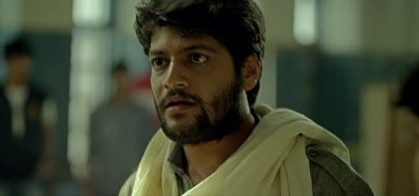
But even for someone like me, who does not know these things, the movie proved worth watching and was easy enough to enjoy and wonder at. While its hero, as well as that scary/sexy teacher (shown above), may sometimes strike you as too much like that smarty-pants kids in your drama class who always knew everything better than anyone else and never wanted to abide by any rule, still, these characters and the movie they inhabit consistently strike a chord of genuine exploration, caring and the will to change.

For me the movie's most moving moment comes near its close, when our hero can finally admit and accept what and who his mother actually was. There is plenty else here, too -- from humor and surprise to amazement and shock. And lots of enjoyment. The biggest problem I had with the film is that it switches back and forth over and over again from Hindi (and occasionally French) with English subtitles to English spoken with rather thick Indian accents without subtitles. I think it would have been wiser to have English subtitles throughout.

In any case, the big screen is the place to see CRD, and it opens today in the Los Angeles area at Laemmle's Town Center 5 and Monica Film Center. Elsewhere? I don't know. But watch for it -- if not at a theater near you then on DVD or digital. Eventually, I hope.

Thursday, November 3, 2016

Schrader/Bunker's DOG EAT DOG gives Nicolas Cage his most interesting role in some time


Compulsively watchable, even as it has you occasionally rolling your eyes, the new film by Paul Schrader and adapted by Edward Bunker from the novel by Matthew Wilder), DOG EAT DOG, is Schrader's most enjoyable, if hugely violent, in quite a few years. From its opening in a pastel-colored suburban home (soon to be heavily blood-splattered) to baby kidnapping-and-murder, it is also his most transgressive -- even given his past array, including The Comfort of Strangers and The Canyons.

Mr. Schrader, shown at right (and below, left), also plays a supporting role in the film, and he does a bang-up job portraying a criminal king- (or at least prince-) pin known as El Greco. I am guessing what attracted him as a filmmaker to this tale of really, really bad guys gone worse is its combo of macho posturing laced with light philosophizing on everything from love and need to religion and violence. In any case, it proves a very good match.

Visually, the film is lots of fun, too. As much as I've enjoyed and respected a number of Schrader movies -- from Blue Collar and Mishima: A Life in Four Chapters to Auto Focus and (especially) Adam Resurrected -- it seems to me that this screenwriter and director is loosening up quite a bit from his earlier, more restrained elegance (remember American Gigolo?) to a more relaxed and occasionally even enjoyably florid visual sense.

As restrained as proves Nicolas Cage in his role as the "leader" of a trio of pretty stupid criminals hoping to do that last job that will set them up for life, he is matched moment for moment by another oft-seen (and oft off-his-noggin) actor Willem Dafoe, who has here his juiciest crazy-man role in some years.

Cage narrates the film in a low-key monotone, which reaches its apotheosis in the final moments with a dark, ugly but maybe on-the-nose appreciation of us humans and our motives. Beforehand we're treated to the three first-class performances of Cage, Dafoe and the other member of the trio, a big, bald, beefy lug played with equal parts finesse and frightening menace by an actor new to me, Christopher Matthew Cook (below, right) -- who would steal the film were it not for his co-stars

The women on hand are more or less cursory, but several of them are given very nice scenes to play -- usually with fear and/or loathing, given the characters of the men they're up against -- and they accomplish this with some panache.

The old honor-among-thieves gets the usual workout here, but so dishonorable in so many way is our little group that it takes the film into new realms of betrayal. To note that no one gets out of here alive is to put it rather mildly. The fine cinematography is from Alexander Dynan, and the alternately ugly and gorgeous (oh, that scene in the diner!) production design comes from Grace Yun.

From RLJ Entertainment and running just 93 minutes, the film does not outstay its dark and stylish welcome. It opens this Friday, November 4, in Los Angeles (Laemmle's Music Hall 3) and New York (AMC Empire 25) on November 4th, with a theatrical expansion and VOD to follow on November 11th. The DVD and Blu-ray hit the street on December 27.

Wednesday, November 2, 2016

A parenting/parentage problem brought to life in Anna Muylaert's smart DON'T CALL ME SON


The last time we heard from Anna Muylaert was just last year with her Oscar-submitted for Best Foreign Language Film, The Second Mother, a wonderfully complicated movie in which ironies abound and everything from class and economics to pride and parenting are involved. Ms Muylaert's latest endeavor, DON'T CALL ME SON (Mãe Só Há Uma), is a lot less complicated, while sporting a half-hour shorter running time, too. This does not mean that the movie is any less rich or deep, however. In fact, in just 77 minutes (plus credits), this writer/ director (shown below) manages to believably probe a very fraught situation.

What happens here is that an adolescent son and his slightly younger sister are yanked away from their mother who, it turns out, stole them when they were both babies. Via DNA matches, both kids are reunited with their birth families (or, in the case of the daughter, what's left of that family), whom they neither know nor care to know, while the only mother they have known is tossed into jail.

A situation like this one is unfair to everyone involved but must somehow be handled as best as it can, and in Ms Muylaert's hands it becomes an opportunity to make us think and feel and even smile -- if not outright laugh at times -- without ever getting near anything "fake." (The line, "He looks like my dad," has seldom seemed so moving.) This would be accomplishment enough, but the filmmaker also tosses a few more bombshells into her mix.

The young man (played by newcomer Naomie Nero, at right, above, and center, below) -- originally named Felipe but known as Pierre for most of his life -- is one of those raging hormone adolescents who plays in a rock band, is an androgynous cross-dresser, and has sex with both boys and girls. The family he comes into is of a completely different economic and cultural class than he is used to. And the two mothers -- birth and thieving -- are played by the same actress. TrustMovies would never have realized this, had he not referred to the press information, post-viewing. In any case, that actress -- Daniela Nefussi (at left, above and below) -- is superb: hugely different and completely believable in both roles.

Via adeptly chosen scenes, we view and understand the feelings of everybody toward the situation at hand and how it evolves: the birth mom and dad; that family's younger brother who, of course, views this new addition as the supreme interloper onto his former secure territory; even the social workers involved in the case. The movie also brings up questions that are not so easily answered regarding identity and one's place in the family and the world. This is difficult enough for those of us living what we might call "normal" lives. Seen here, it seems initially maybe insurmountable.

Then the filmmaker gives us just one moment of sweet rapprochement that is simple, smart and rings absolutely true. Ms Muylaert, as they say, has done it again. Don't Call Me Son -- from Zeitgeist Films, in Portuguese with English subtitles and running 82 minutes -- opens today, Wednesday, November 2, in its U.S. theatrical premier at New York City's Film Forum. It opens in Los Angeles at Laemmle's Royal next Friday, November 11, and will hit at least another ten cities over the weeks to come. (In South Florida it opens at Miami's Tower Theater on November 18.) Click here then scroll down to see all currently scheduled playdates, cities and theaters.

Anthony Edwards' MY DEAD BOYFRIEND brings a character, if not a corpse, back to oddball life


How well do we know that person whom we live with and presume to love? Of course, you'll immediately realize that the answer here is going to be
"not very."

But wait. That doesn't begin to cover the manner in which the non-heroine of the new movie, MY DEAD BOYFRIEND, doesn't know her own live-in guy, whom she comes home one day, after being fired at her latest job, to find dead in his recliner, his corpse having been, from all we can tell here, simply watching TV.

As written by actor Billy Morrissette (from the novel by Arthur Nersesian) and directed by actor Anthony Edwards, shown at right, the movie fairly bubbles with the fun to be found (for the audience, if not for the girlfriend in question) in discovering just who this dead guy really was.

Further, as played by John Corbett (shown below, in that recliner, and at bottom, right), this fellow, who goes by the name of Primo Schulz, proves quite the guy who got around -- to various women and occupations -- all of which grow wilder and funnier as the movie moves along. And Corbett gets the chance to behave in a number of ways that we're not used to seeing from this actor.

The actual star of the film is Heather Graham, who plays Mary, Primo's last (or so she imagines) girlfriend, and the one who discovers his lifeless body. Ms Graham, still beautiful and sexy, plays everything here just a tad too annoyed to make us care much about what happen to her. Her character is not particularly likable, and while this is fine so far as some movies go, this one needs a gal to root for. And Ms Graham, who goes from annoyed to further annoyed, until she begins beating people with a cremation urn and wantonly slapping faces, is not that character.

The movie, however, is still rather fun as it romps along, introducing us to a number of smart actors, including Katherine Moennig (above, right), as Mary's best friend; Griffin Dunne (below, right), who plays an admirer of Ms Graham's character, and Gina Gershon who has perhaps the plumiest role as an art dealer, of which Ms Gershon typically makes the most.

In the role of what turns out to be the romantic lead, a young actor named Scott Michael Foster does a creditable job warming up to the movie's anti-heroine.

There's a pretty good soundtrack here, too, and a couple of nice musical numbers -- one of which makes use of that fun little song from the old Mary Tyler Moore show, which was also used recently to better purpose in the much more accomplished movie, Christine.

From Momentum Pictures and Orion Releasing (how nice it is to see that old Orion logo on-screen again!) and running 90 minutes, the movie releases this Friday, November 4, simultaneously in "select theaters" and via VOD/Digital HD. In New York City it will play the Cinema Village. Elsewhere? Not sure, but as it's available both VOD and digitally, if you want to take a look, I am sure you can find it.

Tuesday, November 1, 2016

Barry Jenkins' groundbreaking MOONLIGHT: It's everything you've heard it is -- and more


Personal filmmaking raised to about as high a level as TrustMovies has so far seen, MOONLIGHT proves as quietly magnificent, immediately engrossing and enormously powerful as any film in years, if not memory. How does writer/director Barry Jenkins manage this?  Rather than expound at great length (so much of this has already been done by others), I'll first ask that you see for yourself. You'll be glad you did. (And now I'll expound just a little.)

I must admit that having seen and semi-enjoyed Mr. Jenkins' earlier Medicine for Melancholy, I would not have expected anything this momentous. What this filmmaker, shown at right, has done is give us the Black experience in a way that seems both utterly specific and hugely encompassing. That he has chosen to show us this via a character who is gay (something not exactly considered a "plus" in the Black community) makes it all the more amazing. Further, he has used three very different actors -- who look almost nothing alike facially or in body type! -- to portray the character as a boy, an adolescent and a young man.

Here they are, at left (Alex R. Hibbert, as the boy), below (Ashton Sanders as the adolescent version), and further below (Trevante Rhodes, as the young adult),

What unites these three so disparate-looking males is their very "essence," which Jenkins and his actors have captured beautifully and profoundly via the situations, the dialog (kept to a minimum) and the all-round filmmaking skills. This essence is what holds the film together and slowly allows us to understand the meaning of "character."

The movie is also about identity, where it comes from and what it means to each of us, and how, in terms of responsibility, it is up to us to form our own.

Character building and identity are ongoing things, which Moonlight also helps us understand. The movie begins in media res and ends there, too, In between, we get all we need to enter, understand, and live in the life we encounter here. This is no small potatoes, particularly where the Black experience is concerned, and it's what makes Moonlight such an achievement.

Further, I suspect that this achievement will impact both the black and white communities. Whites will come away from the film more empathetic to the black experience than via any other fictional tale except perhaps The Wire (which still holds the prize for showing us that experience more fully and empathetically than anything else).

The mainstream Black community also has a surprise in store, as it should come away from Moonlight with its own richer and more empathetic understanding of the Black gay male.

Sure, there are all kinds of lessons to be learned here, yet Moonlight seems anything but dogmatic and "teacher-y."  It engulfs you from its first scene and holds you fast through smart storytelling and expert performances. How Jenkins worked with his actors to gain their trust and let them discover that "essence" is an award-winning move all by itself.

The drug culture is a large part of this movie, too, though you will not have seen it expressed in quite the way it is here. (Again, only The Wire can top it in this respect.) That fine actor Mahershala Ali, shown above and below (from House of Cards), plays Juan, the mentor of our youngest iteration, and he's both a drug dealer and father figure.

Women play their own major roles here, too, with Naomie Harris (below) alternately horrifying and heartbreaking as our boy's drug-addled mom, and Janelle Monáe (at bottom) as his more caring, surrogate mother.

There's so much that can be said about this unusual film, the main thing being: Experience it yourself. For its penultimate scene alone, in the restaurant, below (that's André Holland, at right, as our boy's longtime best friend, Kevin), the movie will have you hanging on every heartbeat.

From A24, who clearly has another major Oscar contender here, and running 110 minutes, Moonlight -- after huge critical and box-office response to its NYC and L.A. openings -- hit the Miami area this past weekend at the O Cinema Wynwood, Regal South Beach & AMC Aventura Mall.

Friday, November 11, it opens here in Boca Raton and in the West Palm Beach and Fort Lauderdale areas, as well as expanding further around the entire country. In Dade County, it will play the Cinepolis Grove 15 in Coconut Grove; in Broward County at the Cinemark Paradise 24 in Davie and the Gateway 4 in Fort Lauderdale; in   Palm Beach County at Cobb's Downtown at the Mall Gardens Palm 16 in Palm Beach Gardens and at the Cinemark Palace 20 in Boca Raton. Click here to find the theater nearest you. Then go!